Soft-Core vs Hard-Core Funnels: How Far Does AG1’s Customer’s Story Go?

Sam Olawale
October 5, 2026
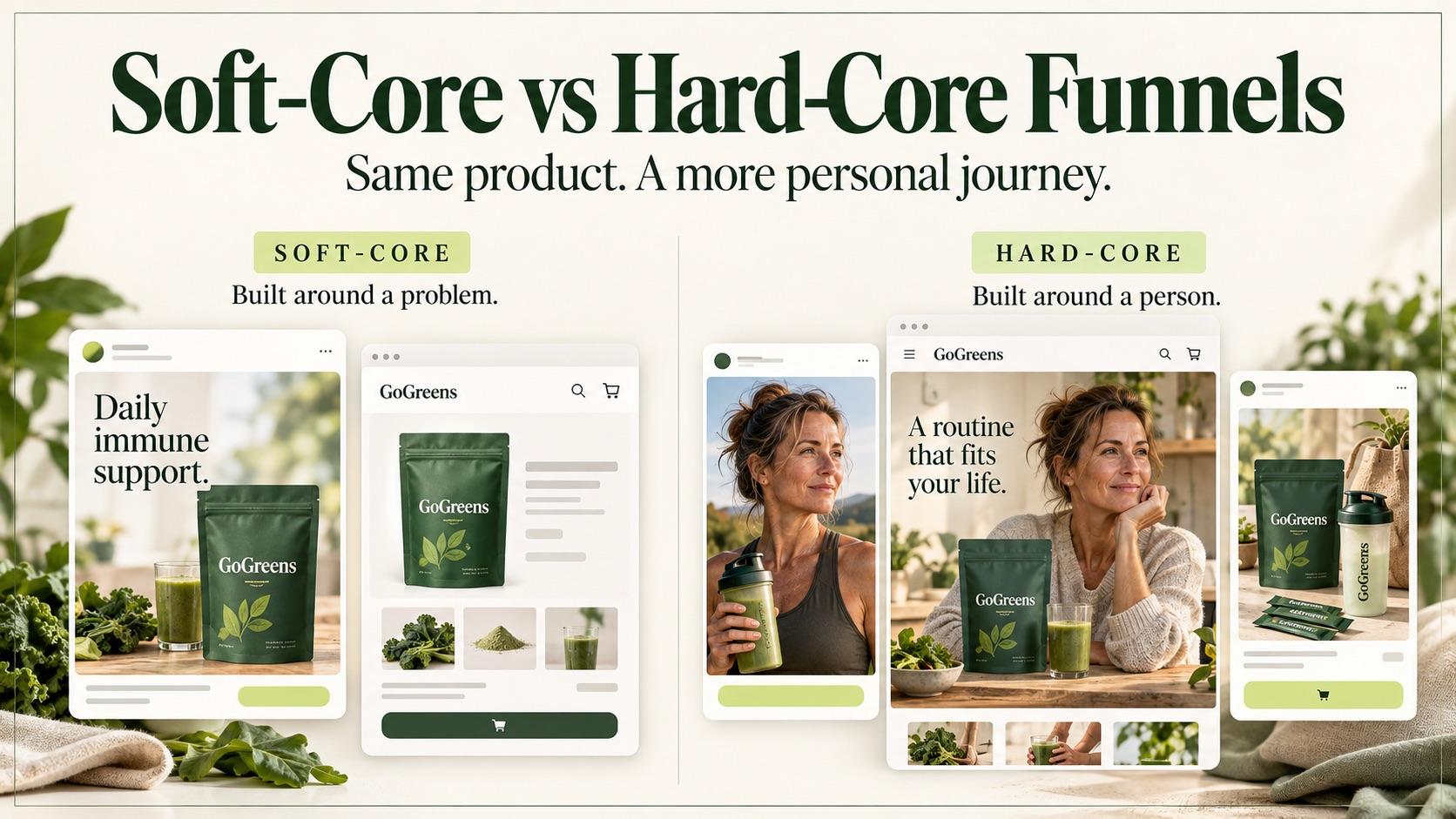
A woman clicks an ad because it speaks to something she cares about.
The page that opens continues the thought. The people look like her. The message feels like it was written with her in mind. For a moment, it feels like the brand gets why she is there.
Then she clicks “Shop now.”
The story disappears.
She lands on the same product page, bundle options, and checkout as everyone else.
The product might still be right for her. But now she has to do the work. She has to work out why this product fits her life, which option to choose, and whether it is actually worth buying.
That is where e-com leaves money on the table.
The more specific the journey is from the first ad to the final offer, the more likely a customer is to keep moving. Better ads can lift CTR. Better pages can lift conversion rate. Better offers can lift AOV. Better upsells can make each customer worth more.
Not because personalisation is some magic trick.
Because the customer does not have to translate a broad product pitch into, “Why is this for me?”
AG1 is a useful brand to look at here. They already do more than most e-com brands. Their ads do not always send people straight to one generic product page. They build pages around different customer groups and buying angles.
But there is still another level beyond that.
First, let us look at what they are doing well.
Funnel One: AG1 Women’s Health
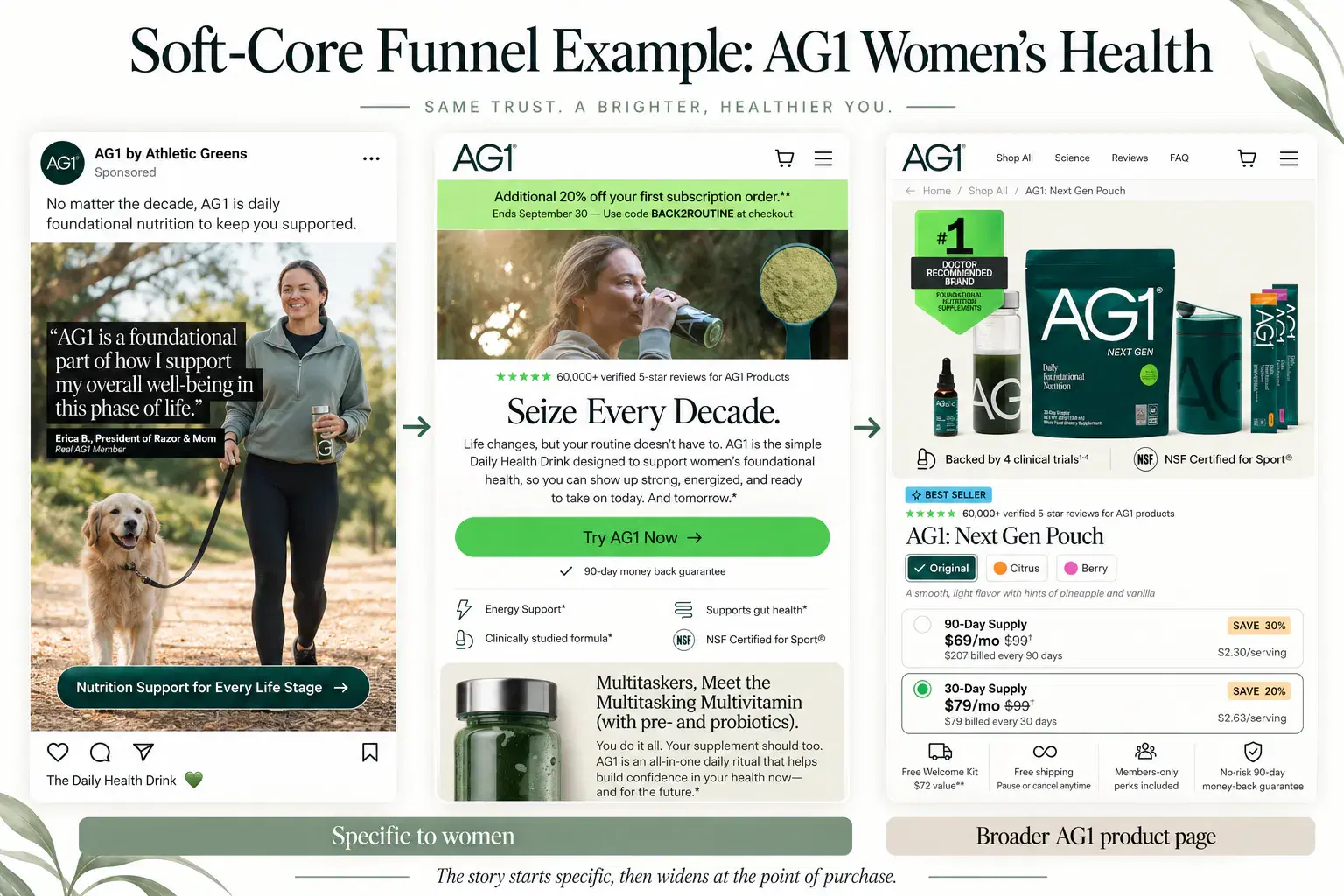
Women’s Health ad → Women’s Health landing page → General AG1 product page
AG1’s Women’s Health funnel begins with a clear audience: women.
The ad speaks about daily foundational nutrition and support through different life stages. The creative is built around women, and that carries through when the customer reaches the landing page.
The landing page does a lot right.
It shows women in different parts of everyday life. It uses social proof that feels closer to the person who clicked. It even frames the reviews as “verified 5-star reviews from women like you.”
Those reviews include a middle-aged woman talking about how important nutrition and gut health are to her, a busy mom and business owner talking about getting nutrients into her day, and a mother of two describing AG1 as part of the routine that helps her keep going.
That is already better than the usual e-com flow.
The ad speaks to women. The landing page speaks to women. The customer does not click on a women’s health message and immediately land in a generic page built for everyone.
Then comes the handoff.
When she is ready to buy, she is sent to the main AG1 product page: AG1 Next Gen Pouch.
That page is built for the full AG1 audience. It leads with broad product messaging, general reviews, a 90-day money-back guarantee, subscription perks, and a Travel Packs option for people who want AG1 on the go.
This is good funneling.
But the customer journey has gone from “women’s health” to “AG1 for adults.”
The story started specific, then widened at the point where the customer actually has to decide whether to buy.
Funnel Two: AG1 Pro Performance
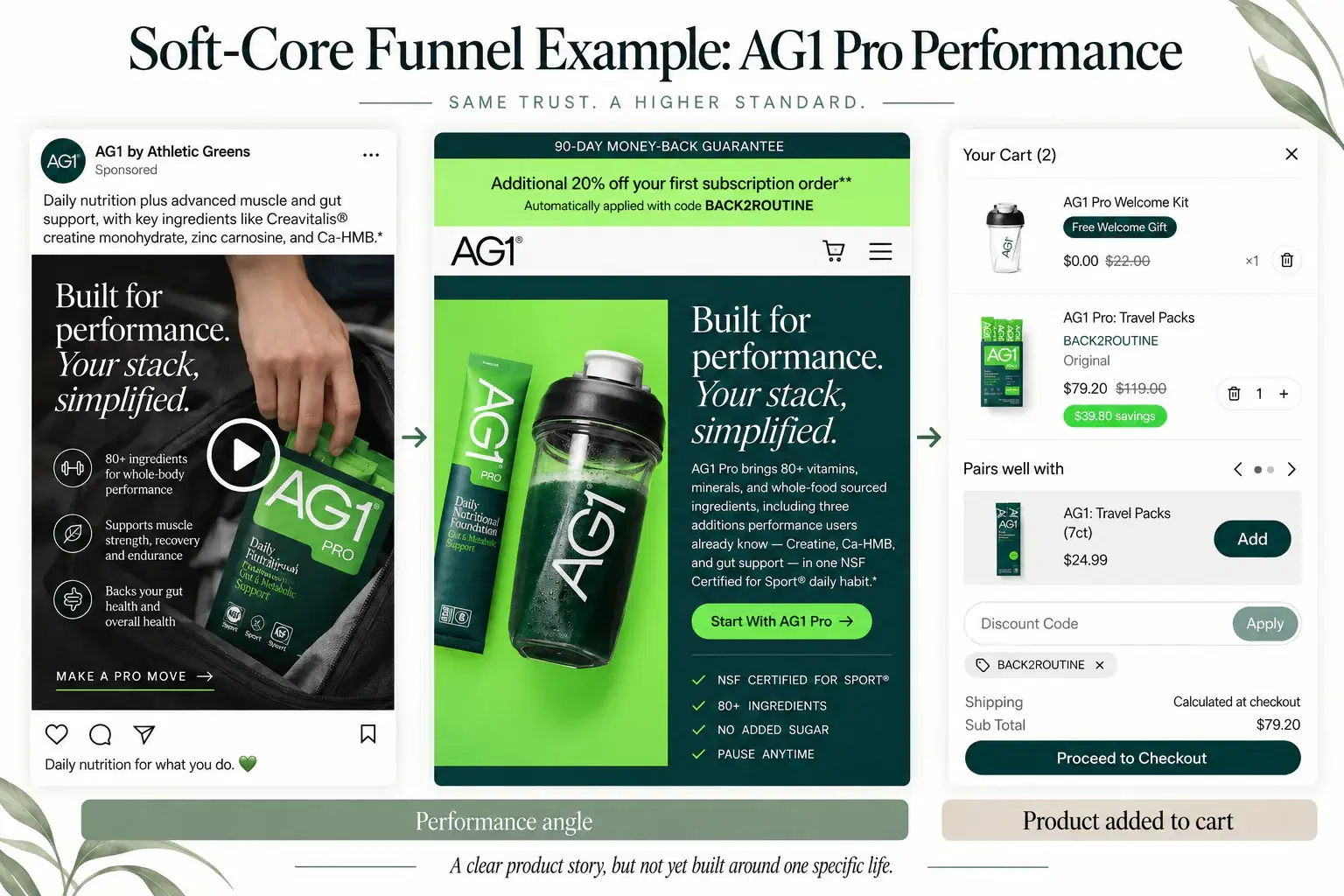
Performance ad → Performance landing page → Product gets added to cart
AG1 Pro takes a different route.
This is a funnel for people who already understand performance supplements. They know what creatine and zinc carnosine is. They probably know what a supplement stack looks like. They may already have a cupboard full of tubs, pills, powders, and half-finished subscriptions.
The main promise is clear:
AG1 Pro does a strong job explaining the product.
It highlights 80+ vitamins, minerals, and whole-food sourced ingredients, alongside three things performance buyers already know: creatine, Ca-HMB, and gut support. It shows 5g of creatine per serving. It compares AG1 Pro against a typical stack of a multivitamin, probiotic, creatine, and HMB. It makes the practical case for one daily serving instead of“a five-bottle morning” and “juggling jars.”
That is a smart funnel.
It speaks to a buyer who is already aware of the category. It answers a real buying question:“Why should I replace several separate products with this one?”
The issue is not that the page lacks information. It has plenty.
The issue is that most of the story is about the product and its features.
It explains the ingredients. It explains the stack comparison. It explains that one product can replace several things.
But it does not fully speak to one clear kind of person and what their life looks like.
For example, a busy professional who trains before work has different reasons for wanting a simpler routine than a competitive athlete, a new gym-goer, or someone trying to get back into training after becoming a parent.
All of them may buy AG1 Pro.
But they are not buying for exactly the same reason.
The AG1 Pro page is focused on the product and its features. A hard-core version would go further and focus on the person buying it.
What AG1 Is Doing
AG1’s Women’s Health and AG1 Pro funnels are both much better than sending every ad to the same product page.
They keep the message going after the click.
Women’s Health is built around a broad customer group.
AG1 Pro is built around a broad performance angle and a supplement-aware buyer.
That is what we call a soft-core funnel.
A soft-core funnel is built around a topic, category, or broad buying angle.
Examples:
- Women’s health
- Performance
- Energy
- Gut health
- Sleep
- Weight loss
- Creatine
- Simplifying your supplement stack
Soft-core funnels work because they are more focused than generic e-com.
But they still stop short of building the whole journey around one specific customer.
That is where hard-core funnels come in.
The Hard-Core Funnel
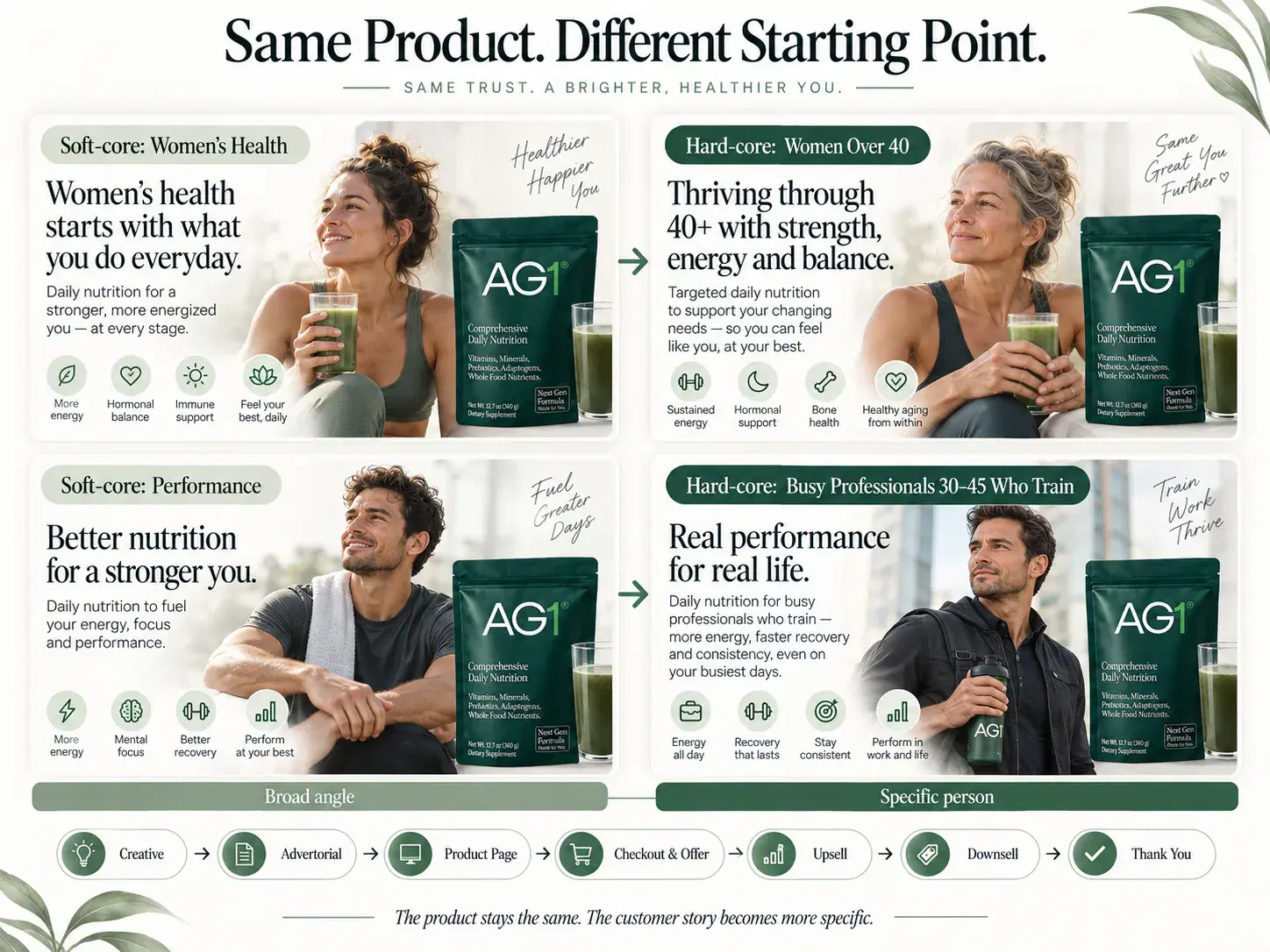
A hard-core funnel takes the same idea and pushes it further.
Instead of building a funnel for “women’s health,” you build one for women over 40, dealing with a specific set of problems.
Instead of building a funnel for “performance,” you build one for busy professionals aged 30 to 45 who train consistently but do not want five separate supplement products to manage.
Those are still big audiences.
But they are specific enough to give you a sharper message, sharper creative, better proof, stronger offers, and a better reason for the customer to buy.
The key point is this:
A hard-core funnel is not just a different headline on the same page.
It is a full customer journey built for one type of person.
Creative → Advertorial → Product page → Checkout and offer → Upsell → Downsell → Thank You
The same person stays in view the whole way through.
The creative feels familiar. The advertorial tells a story they recognise. The product page answers their questions. The offer makes sense for how they will use the product. The upsell helps them get more from the order they just placed.
This is where the lift comes from.
When a customer feels like the funnel was made for them, they are more likely to click, stay on the page, add to cart, complete checkout, choose a larger bundle, and come back again.
That can mean better CTR, conversion rate, AOV, CAC, repeat purchase rate, and LTV.
It is not guaranteed. It still needs testing.
But it is a much stronger version to test than sending everyone into the same broad buying journey.
Women’s Health, Taken Further
Take AG1’s current Women’s Health funnel.
It speaks to women at every stage of life. That gives the brand a broad audience, but it also means the message has to stay fairly broad.
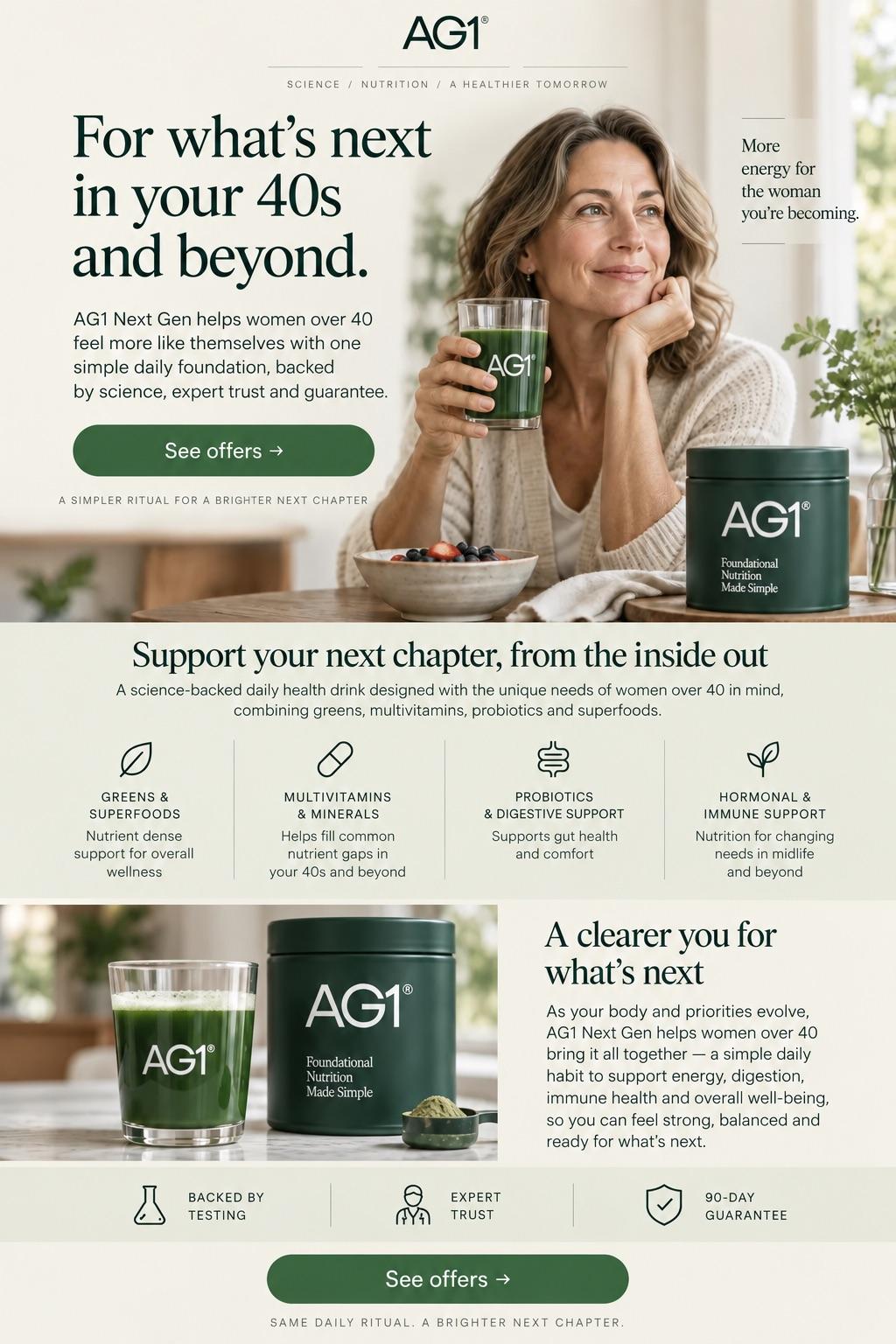
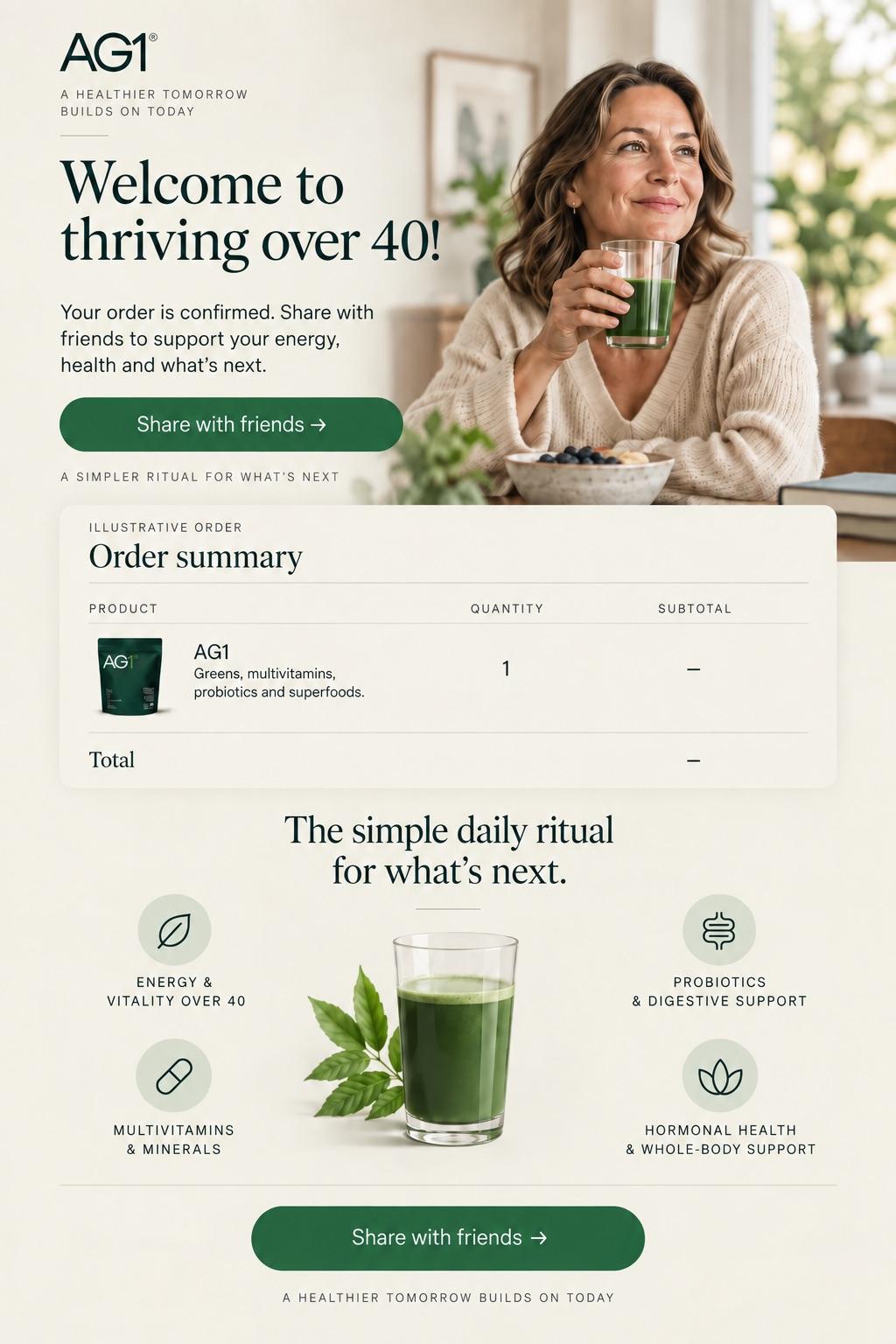
Now imagine the same product sold through a funnel built for women over 40.
The product does not change.
The formula stays the same. The ingredients stay the same. The preparation stays the same. The product claims still need to be accurate.
What changes is the way the customer is brought into the product.
The Creative
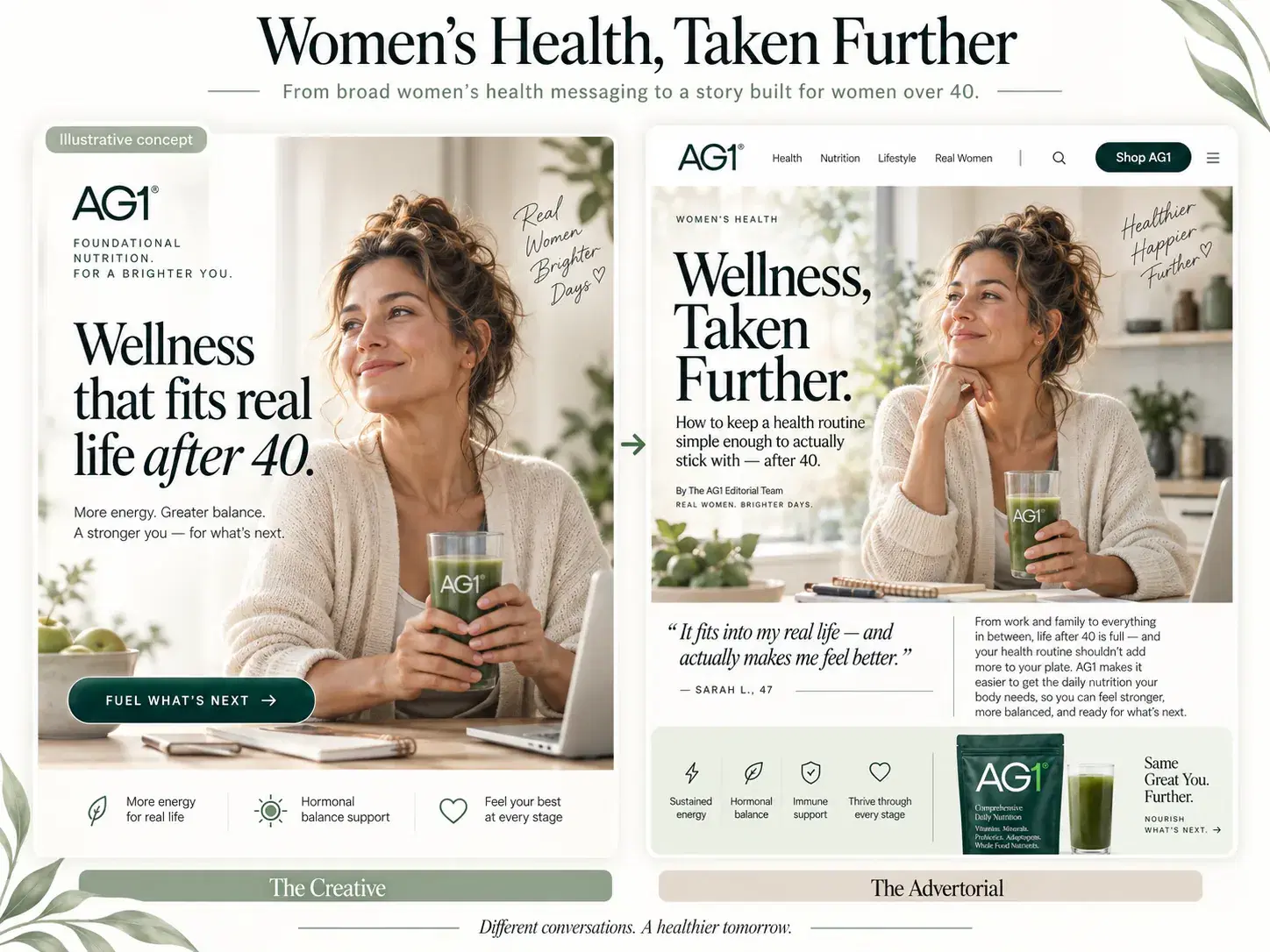
The creative shows a woman over 40 in a part of her real life.
Maybe she is getting ready for a busy workday. Maybe she is packing for a trip. Maybe she is training before everyone else wakes up. Maybe she is taking five minutes for herself before the day starts.
The point is not to say: “This is for women.”
The point is to make the right woman think:
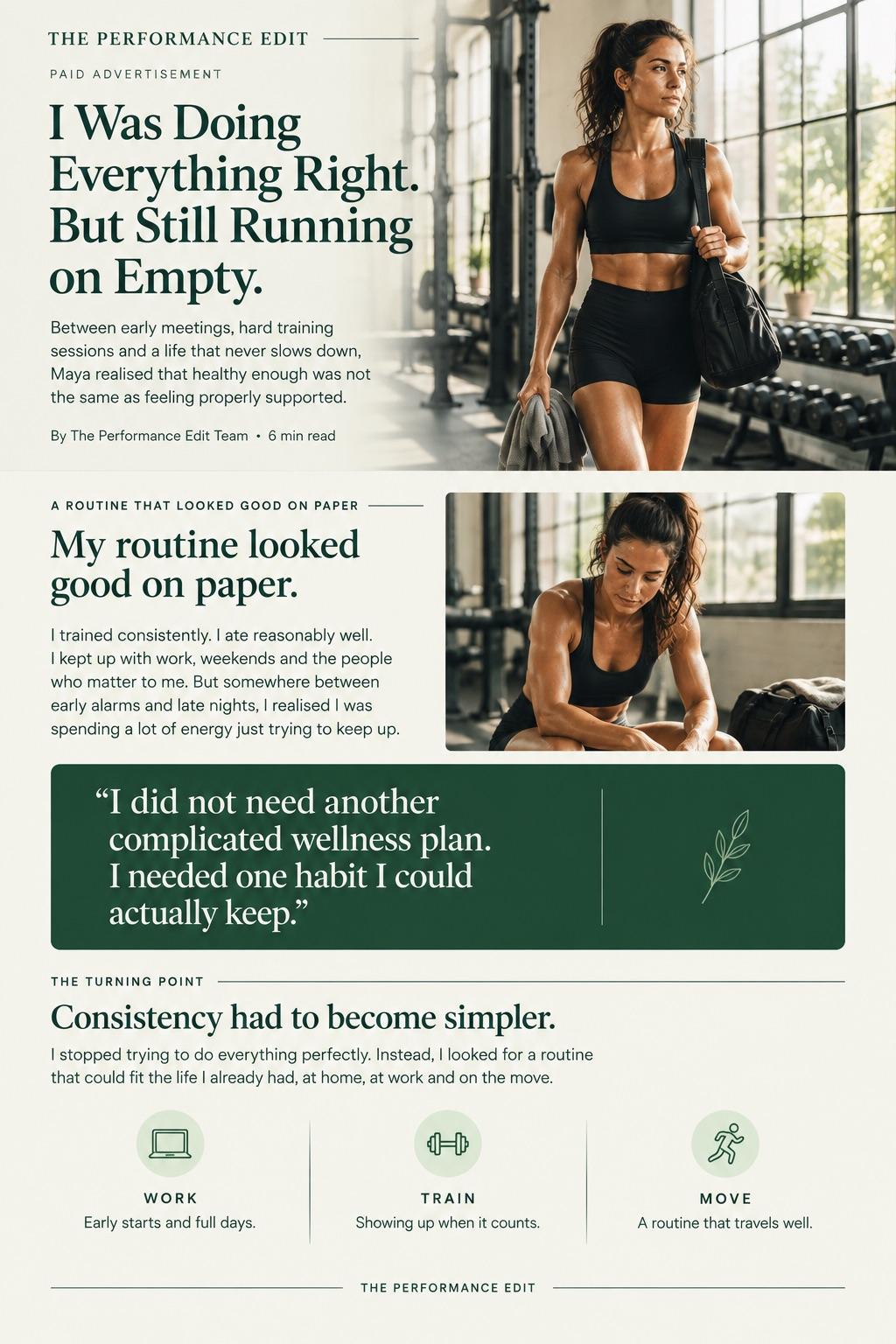
The Advertorial
The next page tells the fuller story.
It can talk about why a health routine has to be simple enough to actually keep. It can show how a daily nutrition habit fits into a packed life without becoming another job to manage.
It gives the customer more than a list of ingredients. It gives her a reason to care.
And it should keep the same visual world from the ad.
If the ad introduces a woman over 40 living a full, active life, the next page should not suddenly switch to generic stock imagery, athletes, or people who have nothing to do with her world.
The Product Page
The product page still needs the facts.
It should explain what is in the product, how to use it, what it tastes like, how delivery works, what the subscription costs, and what the guarantee includes.
But the page should answer the questions of the woman who clicked.
What will this fit into?
Why is it worth adding to my day?
How hard is it to keep up with?
What does this replace?
Why should I choose this over doing nothing, or buying another product that becomes one more thing to remember?
Same product. Different page.
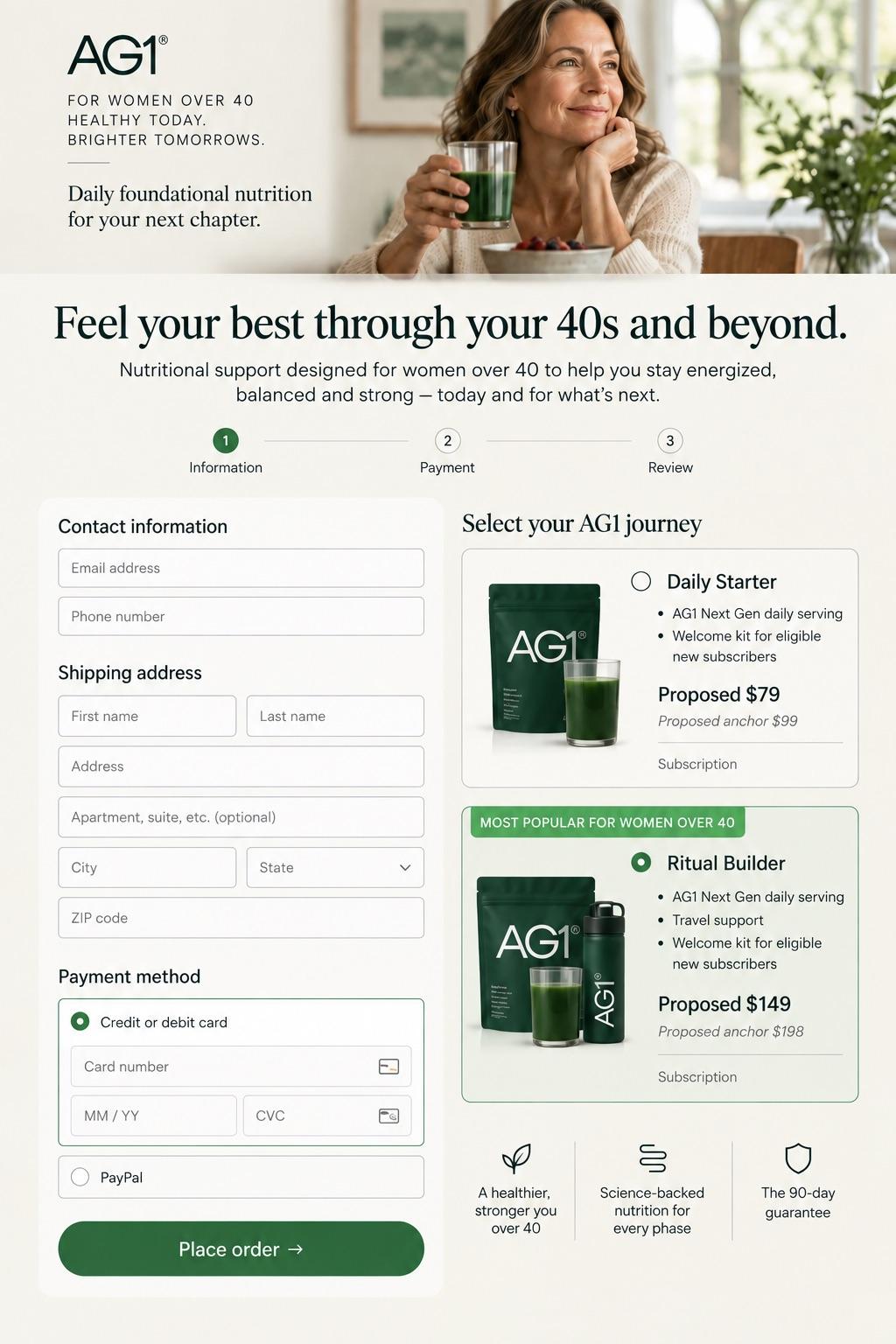
The Offer and Checkout
This is where hard-core funnels go beyond changing copy.
The product can stay exactly the same, but the offer can make more sense for the customer.
| Offer Name | Includes | Why it makes sense |
|---|---|---|
| Your Daily Routine Starter | 30-day supply and shaker | A simple way to start the habit |
| Keep Your Routine Going | 90-day supply | Fewer reorders and less to think about |
| Your Routine, Anywhere | 30-day supply, shaker, and travel packs | A setup for home and days away |
The quantity, price, delivery schedule, renewal date, and subscription terms still need to be obvious.
Nothing is hidden.
Nothing about the product has changed.
The offer is simply more useful for the customer the funnel is built around.
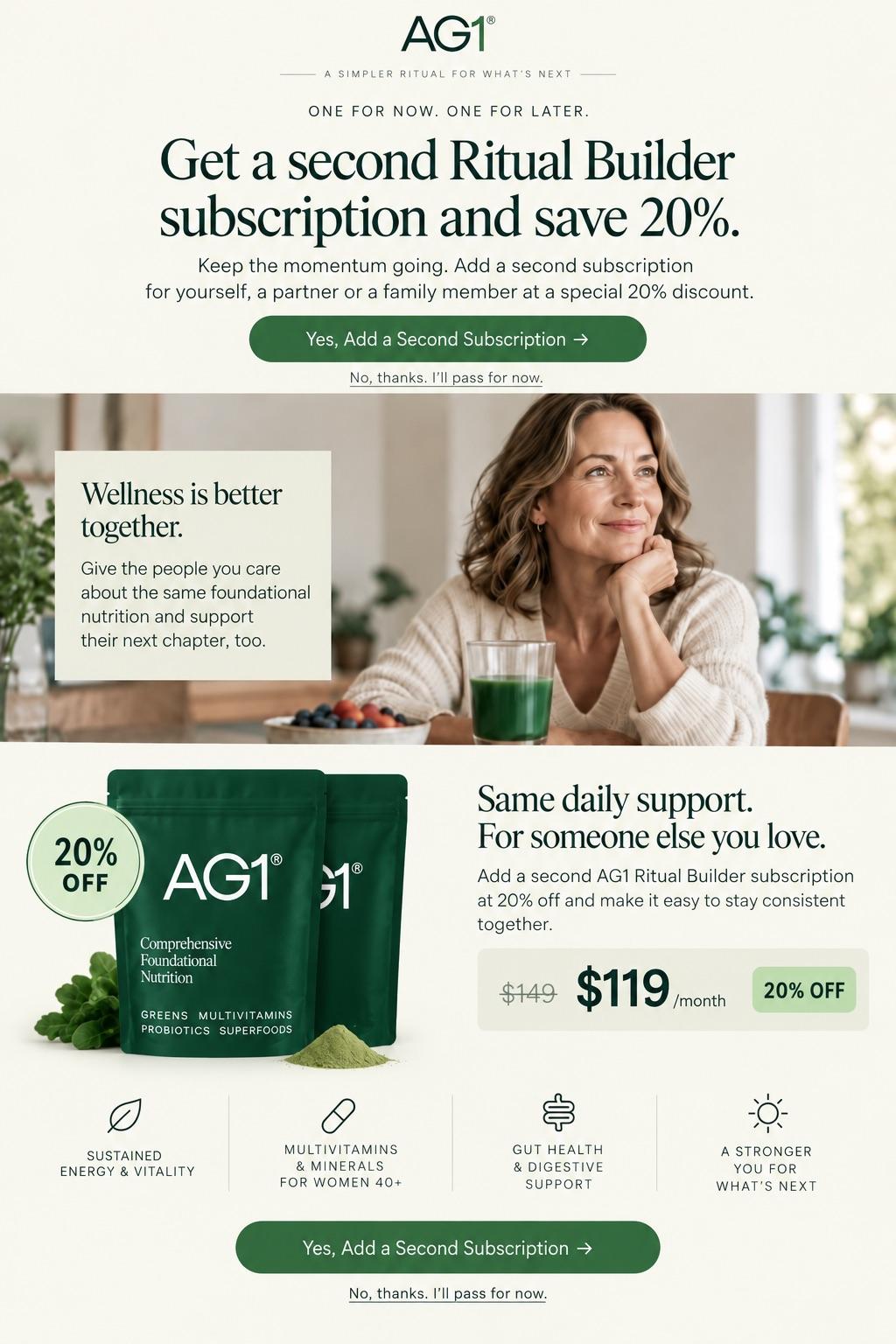
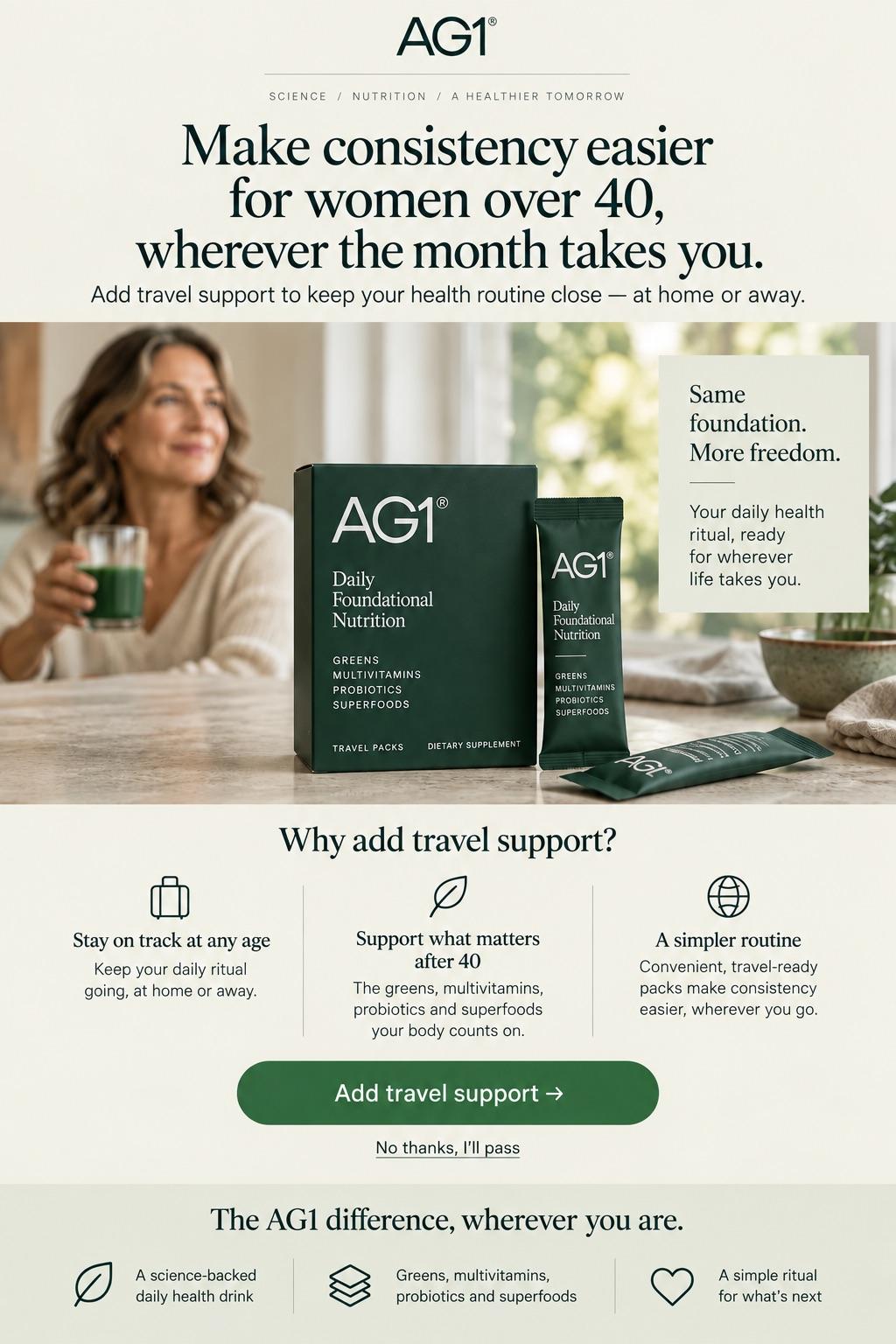
The OTOs: Upsell & Downsell
The post-purchase offers should follow the same logic.
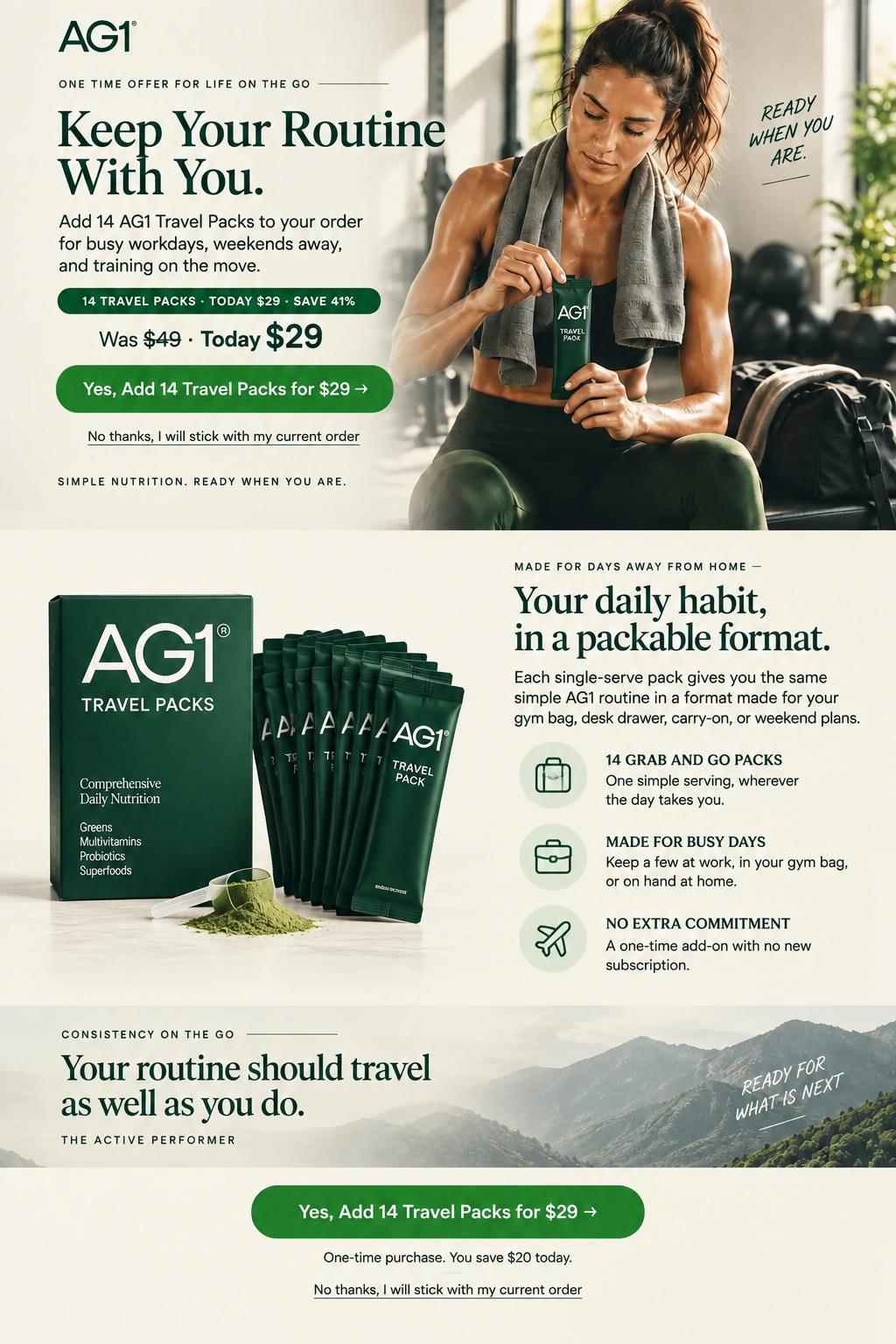
If she picked a starter bundle for home, travel packs might help her keep the routine going when she is away.
If she already chose travel packs, pushing the same thing again does not make much sense.
The best upsell is not just an extra item to push AOV.
It helps the customer get more value from the thing they just bought.
Performance, Taken Further
The same approach works for AG1 Pro.
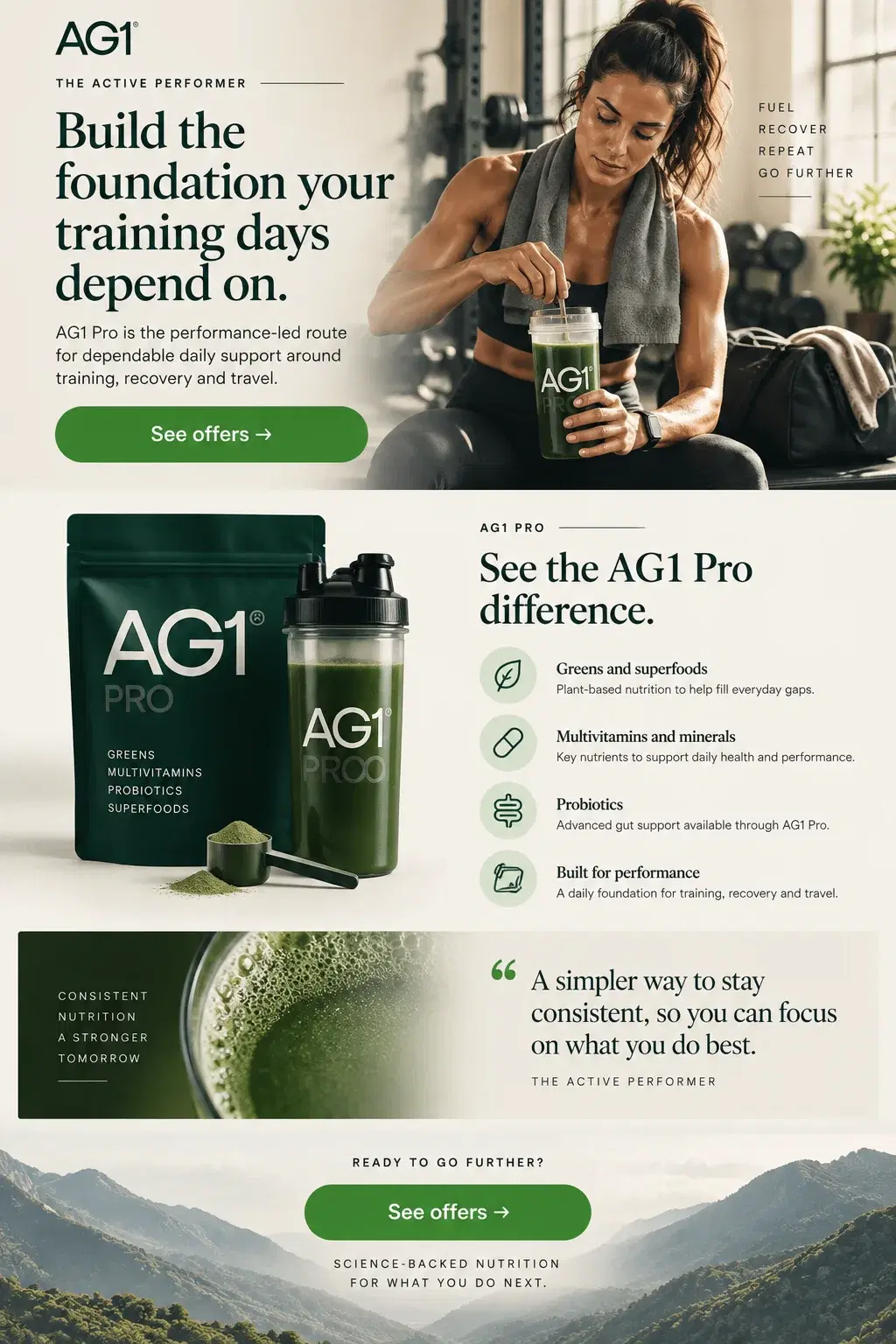
AG1 Pro already has a good product story. It gives a buyer a clear reason to choose one daily product over a stack of separate tubs and pills. It explains the ingredients, the routine, and the practical value of simplifying the stack.
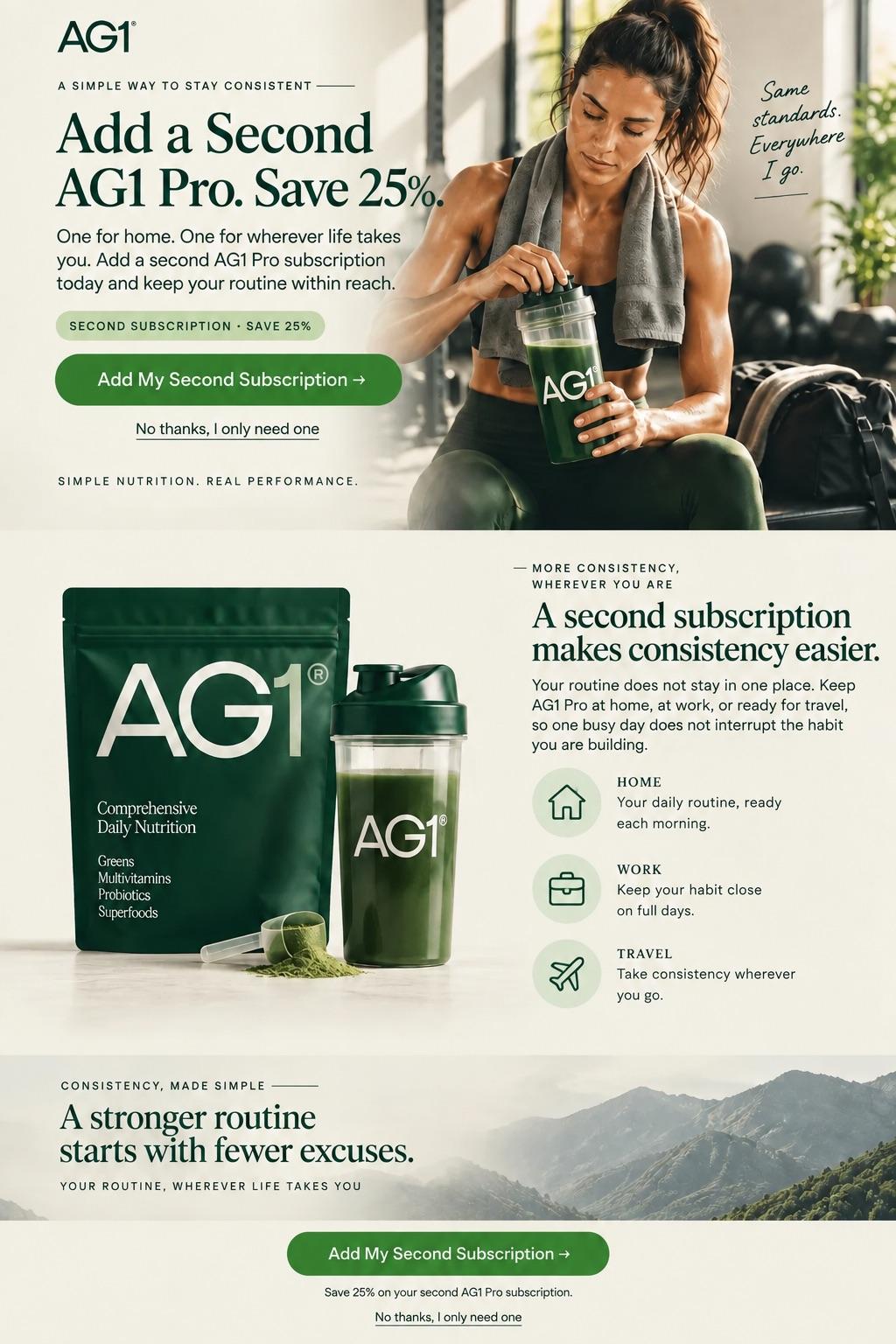
Now imagine a version built for a more specific customer:
Again, the product does not change.
AG1 Pro still has the same 80+ ingredients, 5g of creatine, Ca-HMB, gut-support ingredients, and NSF Certified for Sport status.
But the story becomes more human.
The Creative
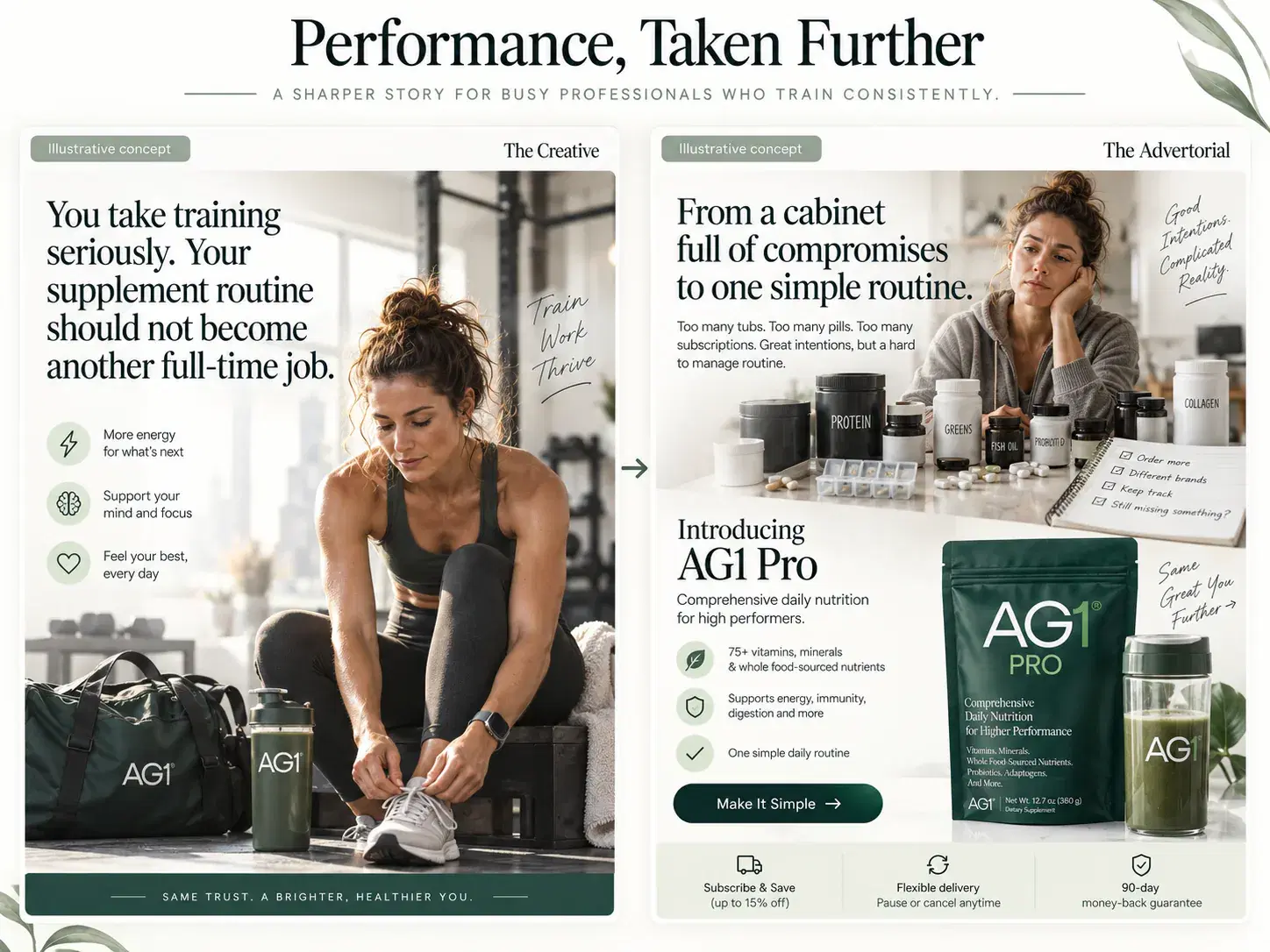
Instead of showing generic performance footage, show the real life around the workout.
A person waking up early to train before work.
Someone fitting in a session after a long day.
Someone who takes training seriously but also has meetings, travel, family, and a full calendar.
The message is no longer only “80+ ingredients, including creatine.” It becomes “You take training seriously. Your supplement routine should not become another full-time job.”
The Advertorial
The advertorial starts with a familiar problem.
A serious gym-goer can easily end up with creatine, a multivitamin, probiotics, greens, recovery products, and several different subscriptions.
Each product may make sense on its own.
Together, they become a lot to manage.
Too many tubs. Too many reorders. Too many things to remember every morning. Too many chances for the routine to fall apart when life gets busy.
AG1 Pro’s existing page already makes the case that one product can simplify a stack. The hard-core version makes that message feel like it was written for someone who is trying to train consistently around a busy life.
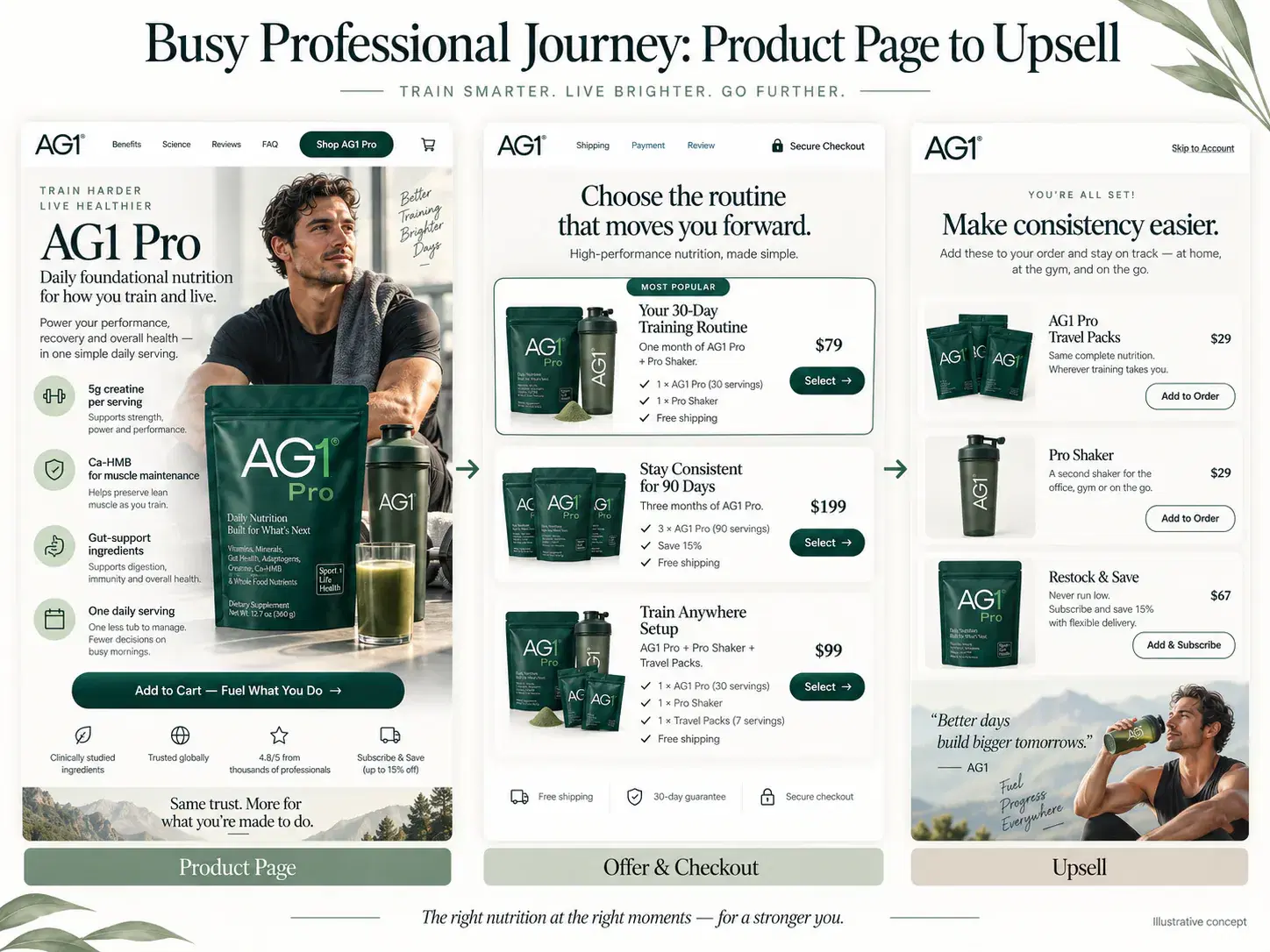
The Product Page
The product page still needs to show the proof.
It can still explain:
- 5g of creatine per serving
- Ca-HMB for muscle maintenance
- Gut-support ingredients
- Prebiotics and probiotics
- A simplified alternative to buying and taking several separate products
But every feature should be tied back to the benefit for that person.
| Product feature | What it means for the customer |
|---|---|
| 5g of creatine per serving | One less tub to buy, measure, store, and remember |
| Ca-HMB and performance support | A simpler way to support a consistent training routine |
| Gut-support ingredients | Less need to piece together separate products for different parts of the routine |
| One daily serving | Fewer decisions before work, before training, or on busy mornings |
| Free Pro Shaker | A ready-to-use setup from the first order |
That is the difference between listing features and showing why the features matter in someone’s actual life.
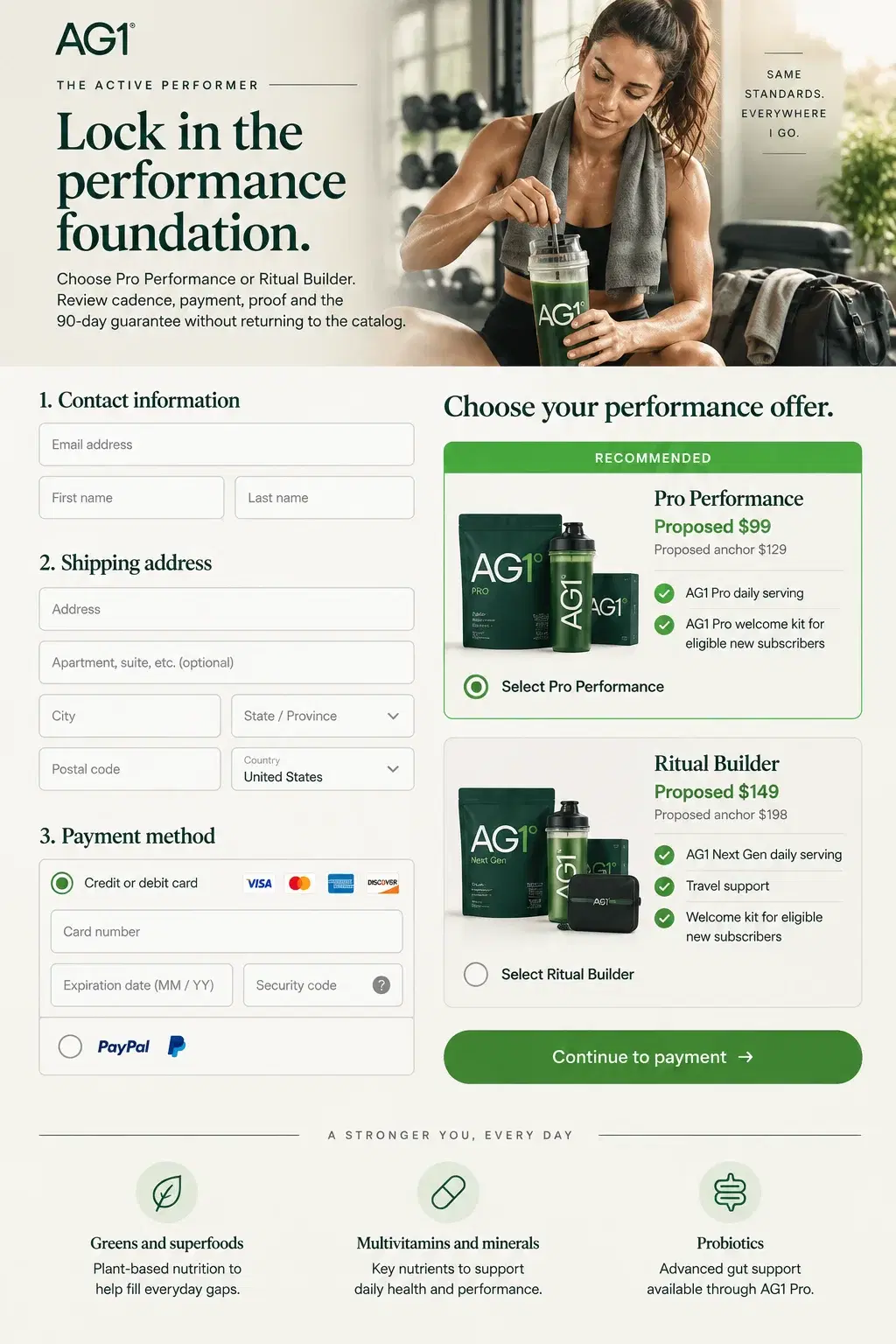
The Offer and Checkout
The offer can also be built around the routine.
| Offer | Includes | Why it makes sense |
|---|---|---|
| Your 30-Day Training Routine | One month of AG1 Pro and a Pro Shaker | A straightforward way to get started |
| Stay Consistent for 90 Days | Three months of AG1 Pro | Less reordering while you focus on training |
| Train Anywhere Setup | AG1 Pro, a Pro Shaker, and travel packs | Easier to stick to the routine during travel and busy weeks |
The product is unchanged. The supply is unchanged. The subscription still needs clear terms.
But the customer is no longer choosing between random quantities. They are choosing the setup that fits how they want to train.
The OTOs: Upsell & Downsell
For this customer, a good upsell might be:
- Travel packs for work trips or weekends away
- A second shaker for home, the office, or a gym bag
- A restock option that helps them avoid running out
The question is simple: Does this make it easier for this person to stay consistent?
If it does, it has a real role in the funnel.
If it does not, it is probably just noise.
Why Most Brands Stop Here
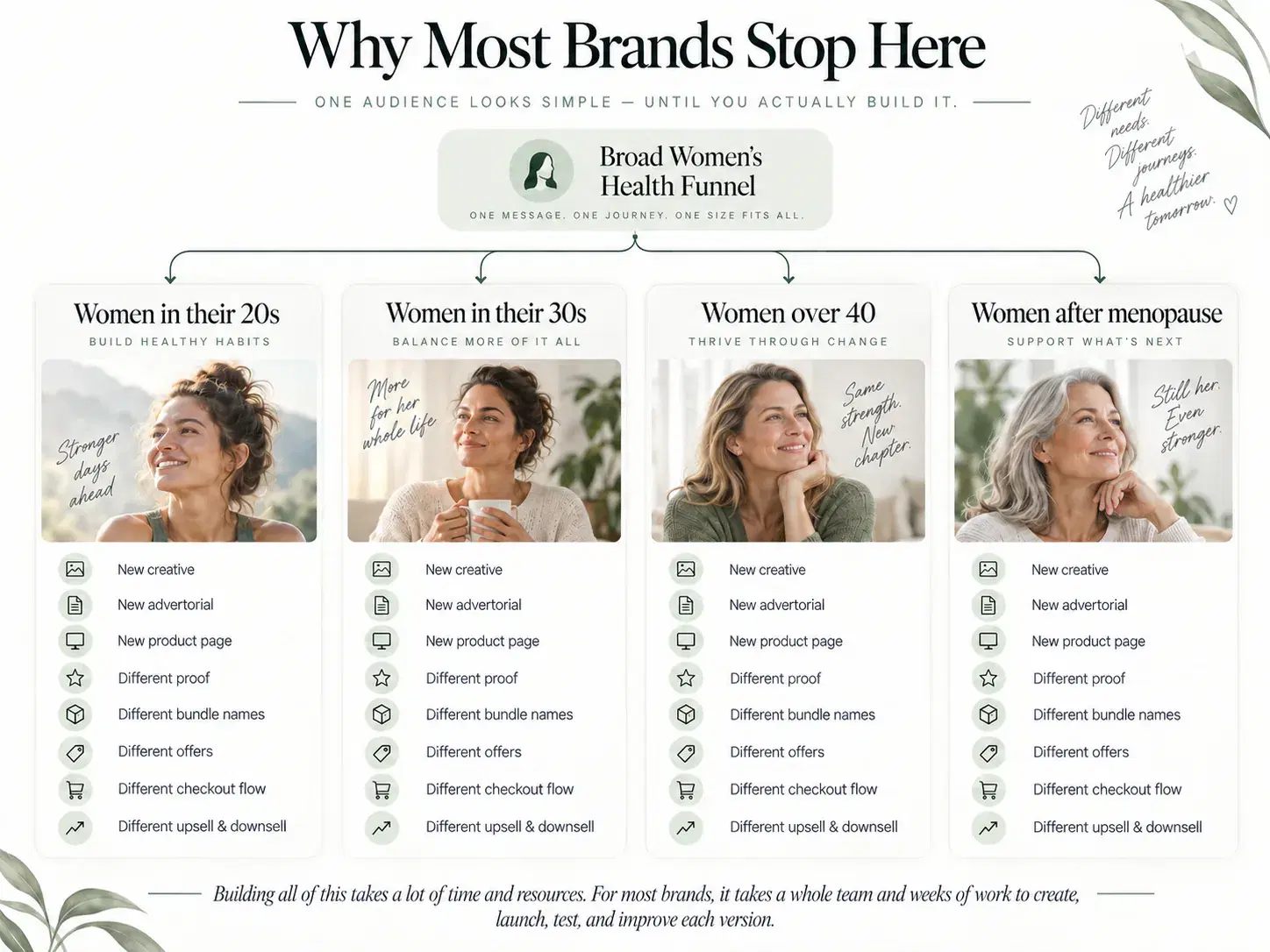
It is easy to understand why hyper-specific funnels can work.
It is much harder to build them properly.
Take a broad Women’s Health funnel.
Then split it into:
- Women in their 20s
- Women in their 30s
- Women over 40
- Women after menopause
Now add different angles inside each group.
Each version might need:
- New creatives
- A new advertorial
- A new product page
- Different proof
- Different bundle names
- Different offers
- A different checkout flow
- A different upsell
- A different downsell
Then you need to write it, design it, build it, check it, launch it, measure it, and change it when the test tells you something is not working.
That is why most e-com brands stop at broad product pages.
It is not because the next step is hard to understand.
It is because building and testing enough good versions the old way takes too much time.
Build Hard-Core Funnels With AlphaWeb
AlphaWeb is built to make this practical.
Start with your current funnel. Use Glow Up to see where the customer story breaks. Where does the ad speak to a specific person, then the next step turn into a page designed for everyone?
Then use AlphaWeb to build the more specific version.
For a women’s health brand, that might mean:
Midlife funnel
The six-page Midlife funnel shows how that connected journey can be carried across every step.

For a performance brand, it might mean:
Performance funnel
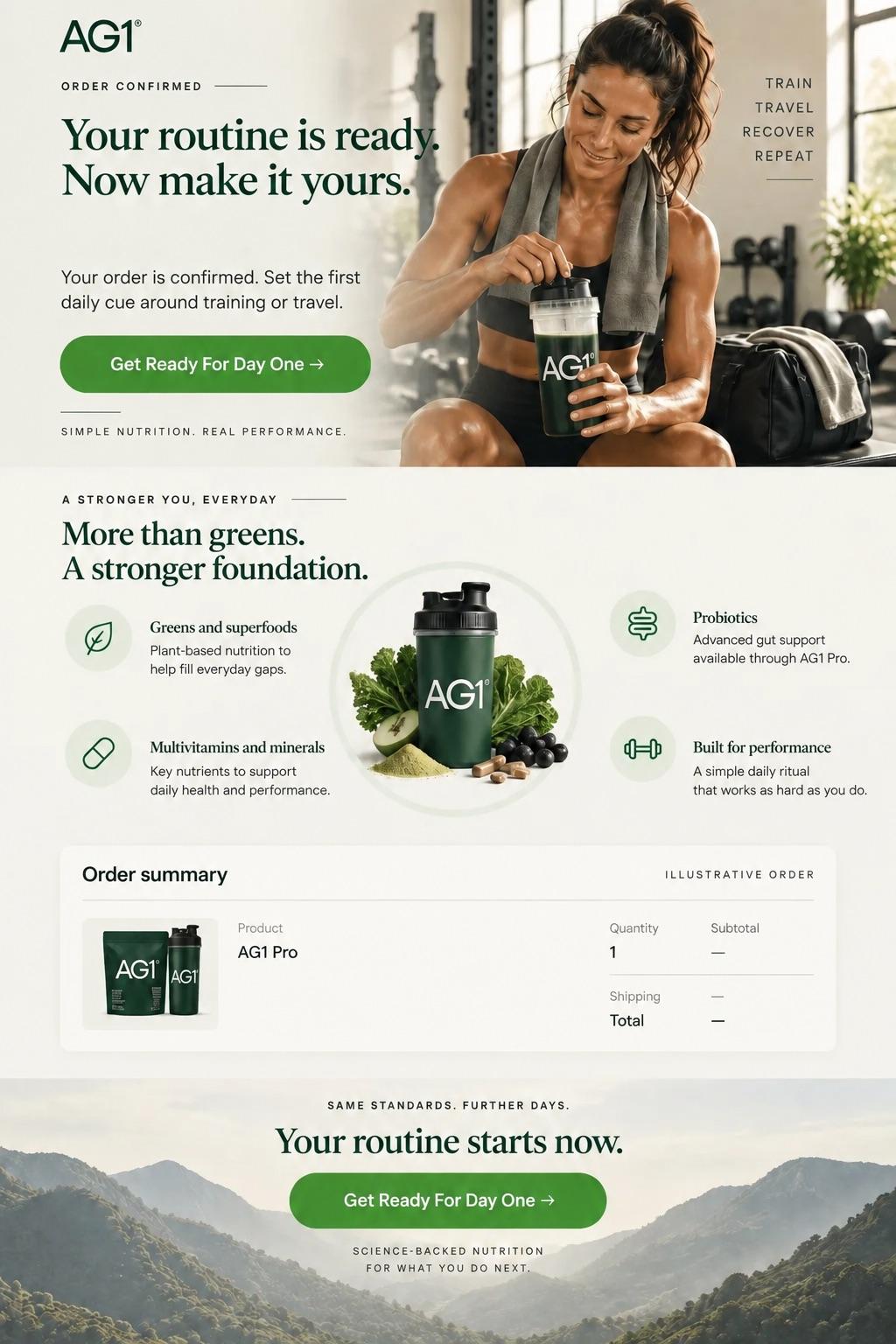
The six-page Performance funnel keeps the same person in view from the first page through the post-purchase experience.
The goal is not to make endless random variations.
The goal is to take a strong customer idea and turn it into a connected funnel you can actually test.
Keep your current journey as the control.
Then compare it with the more specific version.
Look at:
- CTR
- Conversion rate
- Add-to-cart rate
- Checkout conversion
- AOV
- CAC
- Margin
- Repeat purchase rate
- LTV
A hard-core funnel is not guaranteed to win.
But it gives you a much better shot at turning the right message into a buying journey that makes more money.
Build the Version That Stays With Them
AG1 shows what good soft-core funneling looks like.
They keep the message going after the click. They build focused landing pages. They give different types of customers a better first experience than most e-com brands do.
The next level is taking that same idea all the way through.
A hard-core funnel doesn’t need a new product.
It needs a better way of selling the same product to a specific customer.
A creative that feels like it was made for them.
An advertorial that tells their story.
A product page that answers their questions.
An offer that fits their routine.
A post-purchase offer that helps them use what they bought.
Run your current funnel through the AlphaWeb Brand Glow Up today and make a full plan of how to build your own hard-core funnels and scale your business!
Run your free Glow Up
See where your customer story breaks and choose the first hard-core funnel you want to build.