One Hero Product, a $2 Billion Valuation: Inside AG1’s Ecommerce Machine

Sam Olawale
September 21, 2026
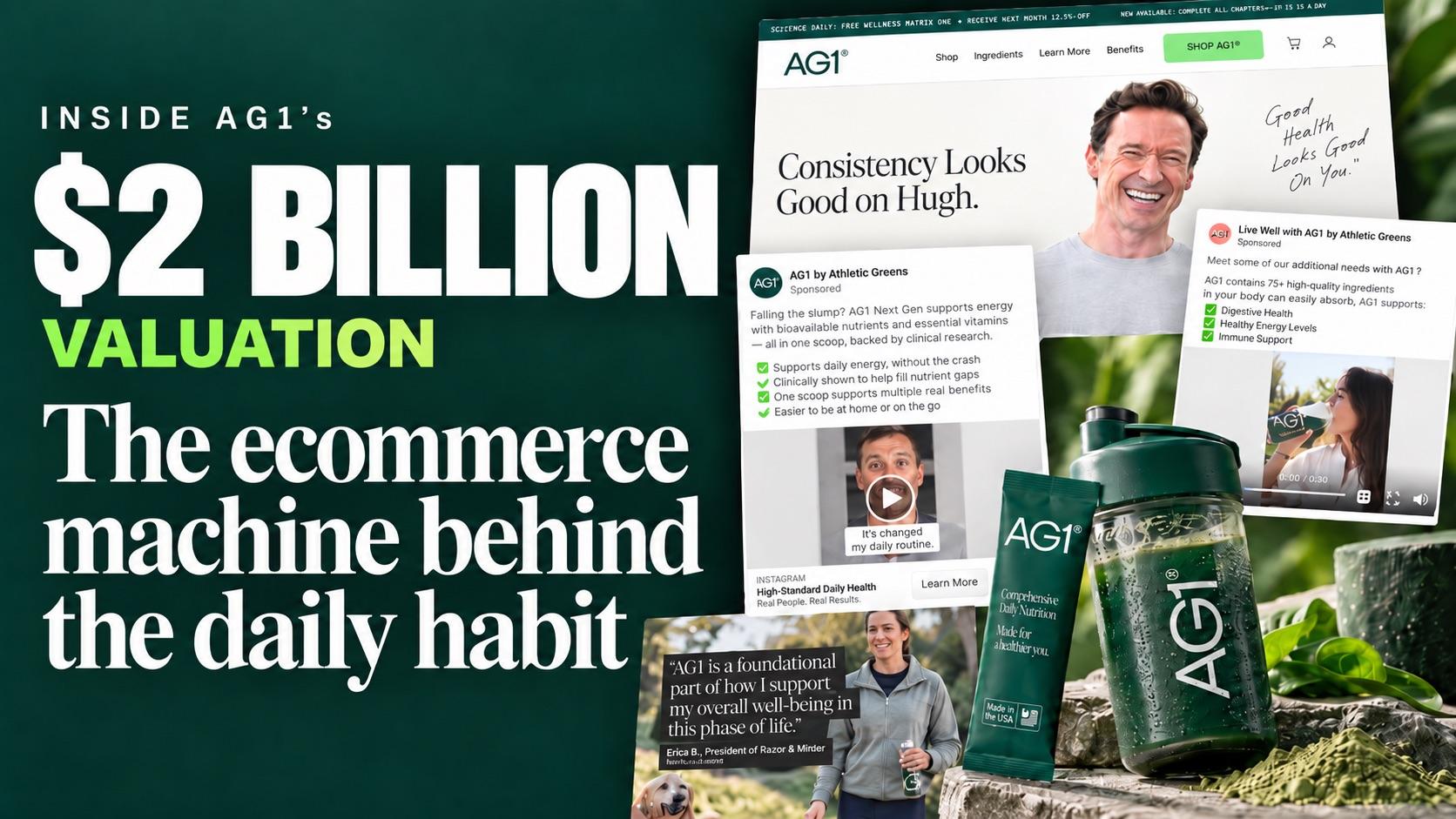
AG1 reached a $2 billion valuation in 2022 and reportedly generated around $600 million in revenue in 2024. For a business selling a daily scoop of green powder, those are extraordinary numbers.
For most of that climb, the business revolved around one hero product.
What began as Athletic Greens became AG1: a shorter name, a more premium identity, and a proposition built around “foundational nutrition.” One scoop became a daily ritual, with advertising, landing pages, subscription offers and retention all built around making that ritual stick.
That makes AG1 worth studying even if you never plan to sell a supplement. How does the same daily habit become compelling to different people? And if there is room to improve a machine this strong, what might be hiding inside your own brand?
How AG1 shows up everywhere
AG1’s acquisition starts long before someone reaches its website.
Podcasts put the product inside routines listeners already trust. When a host you spend hours with each week talks about their morning scoop, the recommendation arrives with a relationship attached. Repeated exposure builds familiarity, so a later ad has less explaining to do.
On Meta, the creative examples span polished video, creator footage, static images, expert appearances and customer stories. That variety suggests a testing approach built around different people, problems, benefits and offers.
The message also changes with the audience.
- Offer ads emphasise gifts and subscription value for people who already know the brand.
- Expert appearances help establish credibility.
- Persona ads give a benefit a recognisable setting: someone with a demanding job trying to keep a routine together.
“Energy support” becomes more interesting when you can see why someone needs it.
Inside three AG1 funnels
These three journeys show how AG1 gives different customers a reason to care, from the first ad through the buying experience.
Women’s health: recognition, then a broader message
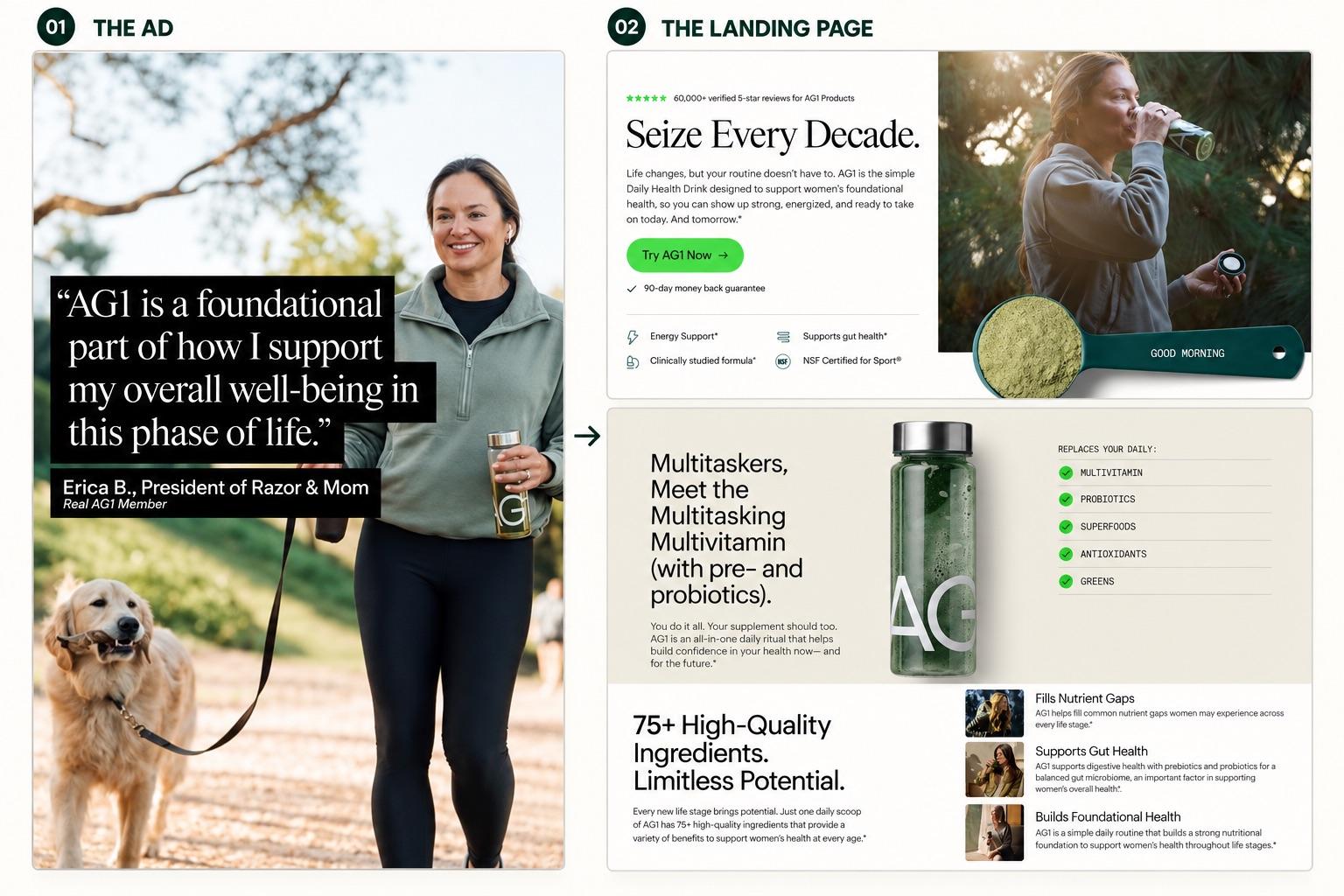
The women’s health ad promises nutrition support through different life stages. The same woman appears on the landing page, alongside women in demanding roles and athletes including Allyson Felix and Sloane Stephens.
Reviews from “women like you” reinforce the feeling that this page understands its audience. The angle is still broad, speaking to women across life stages, but the imagery and proof give the visitor people she can recognise herself in.
Then she clicks to buy and reaches the main AG1 product page. The message widens to daily nutrition for adults generally. Ingredients, guarantees and subscription benefits take over from the women’s health story.
The journey becomes less personal just as the purchase decision gets closer.
AG1 Pro: a simpler performance stack
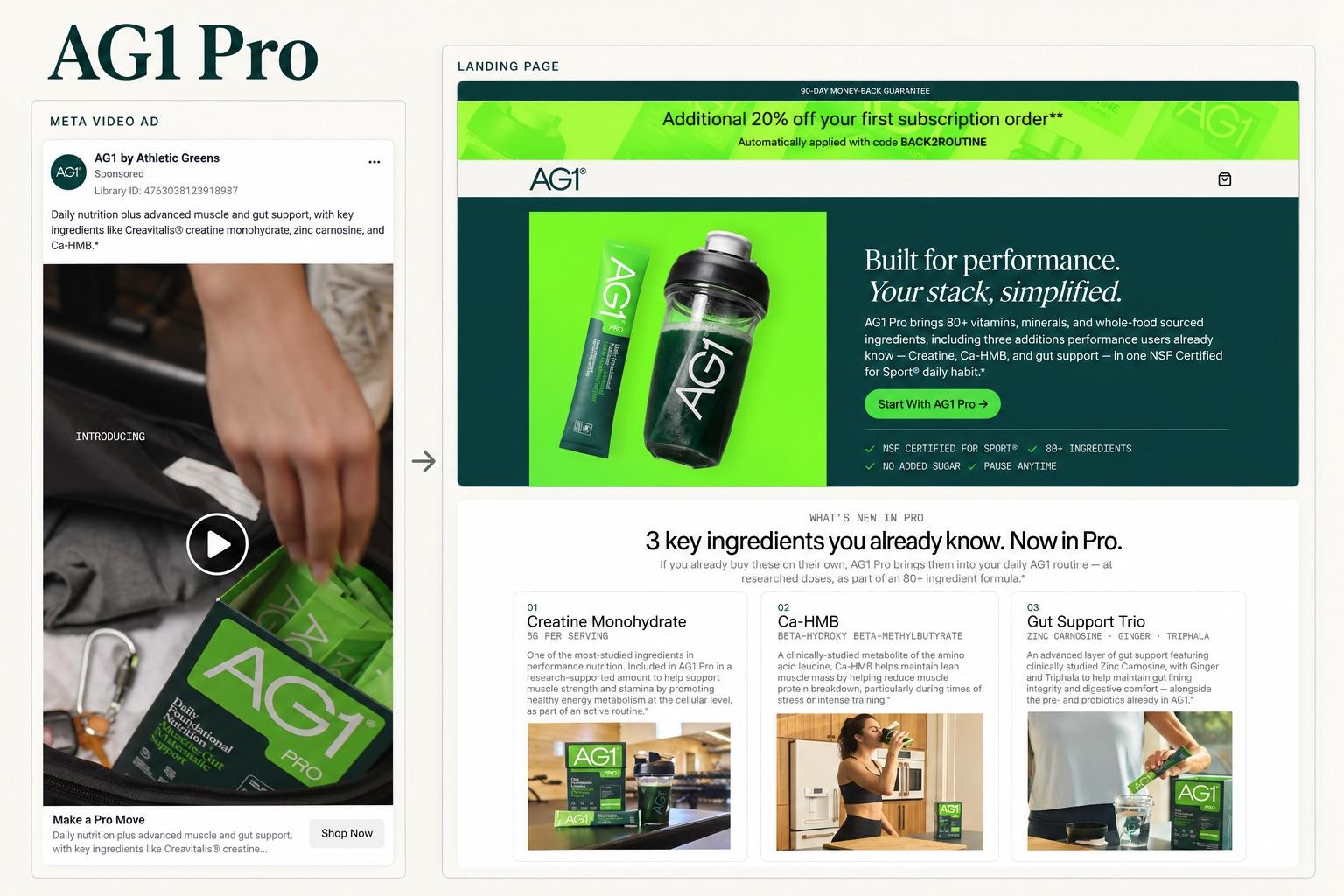
The AG1 Pro ad leads with product shots, lifting and cycling, and 80+ ingredients, including creatine. This performance variant speaks to a different buying motivation.
Its landing page makes the proposition clear: “Built for performance. Your stack simplified.” A comparison shows multiple supplement tubs and pills against one AG1 Pro routine.
The funnel assumes a customer who already understands performance supplements and wants fewer products to manage. Ingredients and comparisons do much of the selling. There is less emphasis on a particular person’s day, such as a busy strength athlete fitting training around work.
Energy support: Rachel’s story pulls you in

The energy ad follows Rachel B, a firefighter and AG1 member. She makes her drink, heads to the station, puts on her gear and trains. Her story is about demanding work and 48-hour shifts, where meals, sleep and plans can be interrupted by a call.
Now the energy angle has stakes. You can picture the day she is trying to get through.
The landing page leads with “Energy support without the crash,” but its opening image switches to a male tennis player. Rachel reappears further down, alongside ingredient explanations and clinical study summaries covering one, two and three months.
The energy theme continues, but the firefighter’s specific world becomes one example among several. Clicking through to buy returns the visitor to the general product page again.
That shift raises a useful question: would more people buy if the experience stayed close to the story that made them click? Public pages alone cannot tell us the answer, but they give us something concrete to test.
How AG1 turns the first order into a habit
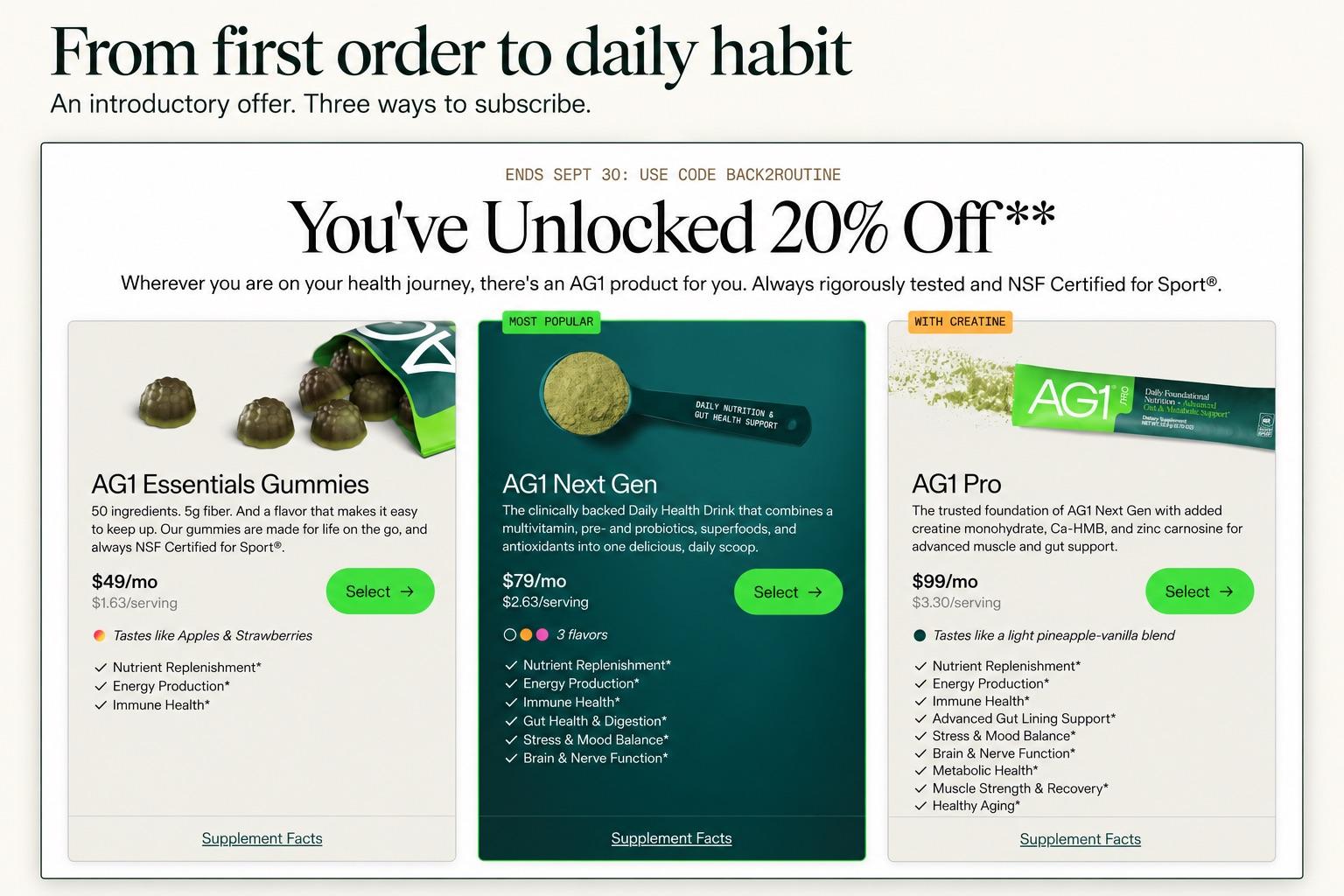
AG1’s offers are designed to make subscription feel easy to start. The main product page defaults to subscription, supported by free shipping, a 90-day money-back guarantee, and the ability to pause or cancel.
AG1 Pro adds 20% off the first subscription order with a code and a free shaker. The energy page’s study timelines reinforce the idea of continued daily use.
Together, those elements reduce purchase hesitation and give customers a reason to keep going. The opportunity is to explore how the offer and onboarding could fit the particular routine that brought each customer in.
The lever smaller brands can pull
Most brands are not going to have Joe Rogan or Hugh Jackman helping create demand. They cannot rent trust at that scale.
Specificity is a lever they can pull.
They can build hyper-specific customer journeys around valuable groups of buyers, carrying each person’s reason to care from the first ad through the offer, checkout and ongoing relationship.
Imagine a more targeted journey, where women and men might have different starting points. Then we could get closer to the customer’s actual life: a frequent traveller maintaining a routine between flights, a parent whose mornings revolve around getting children out the door, or someone training before work who wants fewer supplements to manage.
The product stays the same. The situations, objections, proof and practical reasons to buy change.
What that could look like beyond “women’s health”
For AG1, the existing “women’s health” journey could be the starting point for several hyper-specific customer journeys built around the same core product.
A mother trying to rebuild a personal routine, a frequent traveller fitting nutrition around days away, and a woman balancing regular training with a demanding career might consider the same product for different reasons. Each journey would begin with that particular situation.
For the frequent traveller, the ad could open with:
The landing page would carry that thought forward, showing how portable servings fit into packing, hotel stays and mornings away from home. Genuine reviews from customers who travel regularly would sit alongside product evidence supporting the benefits being discussed.
The offer would follow naturally: a starter bundle with a shaker and portable servings, with an optional travel pack at checkout. Welcome emails would help the customer establish a routine that travels with them, while subscription reminders would make it easy to adjust deliveries around actual use.
The other audiences would get their own stories, relevant proof and purchase experiences. The product stays the same. The reason to buy shapes the entire journey.
These would be candidates to test against the existing funnel. Keep the control, build focused challengers, and let results determine which journeys earn more traffic.
Why the maths matters
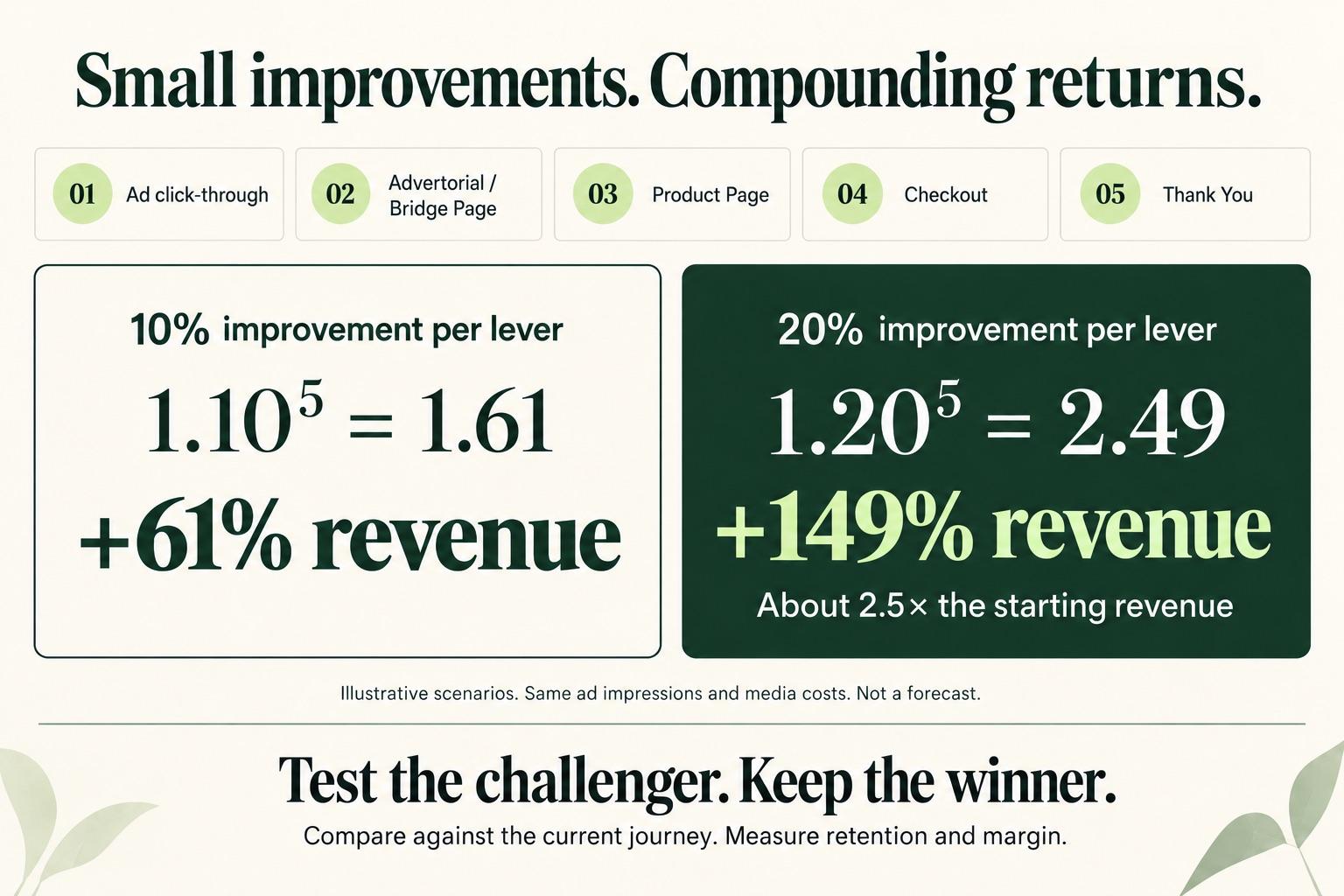
Consider five levers: ad click-through rate, the share of page visitors who start checkout, checkout completion, average order value, and the number of orders each customer places over time.
That final lever captures the retention component of customer value separately from order value, so the same gain is not counted twice.
If each improves by just 10% relative to its starting point, the combined effect is:
At 20% per lever, it becomes:
Those are illustrations with the same number of ad impressions and media costs held constant, not forecasts for AG1 or your brand. The point is that modest improvements across a connected journey can compound into a much larger result.
The challenger still has to earn its place. Keep the existing journey as the control, split comparable audiences between the two, and measure the commercial outcome. Track click-through, page conversion, checkout completion, order value and subscription uptake, then follow retention and customer value as they emerge. Account for margin, too: a more generous bundle costs money.
Keep what performs better. If the challenger loses, use what you learned to build the next one.
Build your version with AlphaWeb
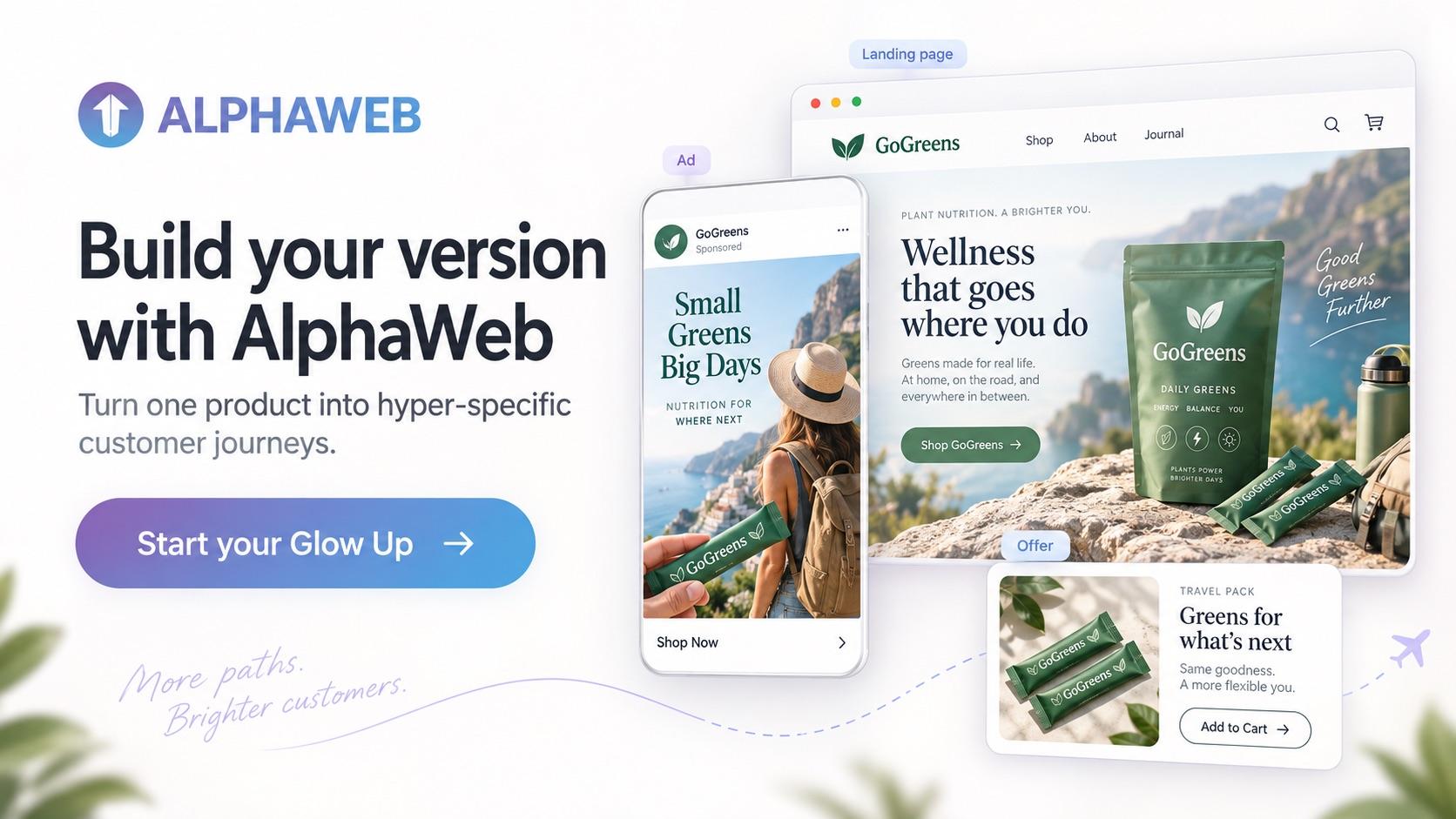
The practical obstacle is producing these journeys. Even one requires customer research, competitor analysis, copy, creative, pages, offers and a coherent plan. Building several can quickly stretch a small team.
AlphaWeb uses AI to bring that work together. The starting point is Glow Up, our free analysis tool.
Give it your website or brand, and it analyses your business, customers, competitors, creatives, pages and offers. You get a Glow Up Score, an assessment of where revenue may be leaking, and a clear plan for what to test next.
From that analysis, AlphaBrain can help develop personas, stories, offers and complete funnel directions that fit your product, brand voice and economics. The strongest opportunities become hyper-specific customer journeys you can build and test.
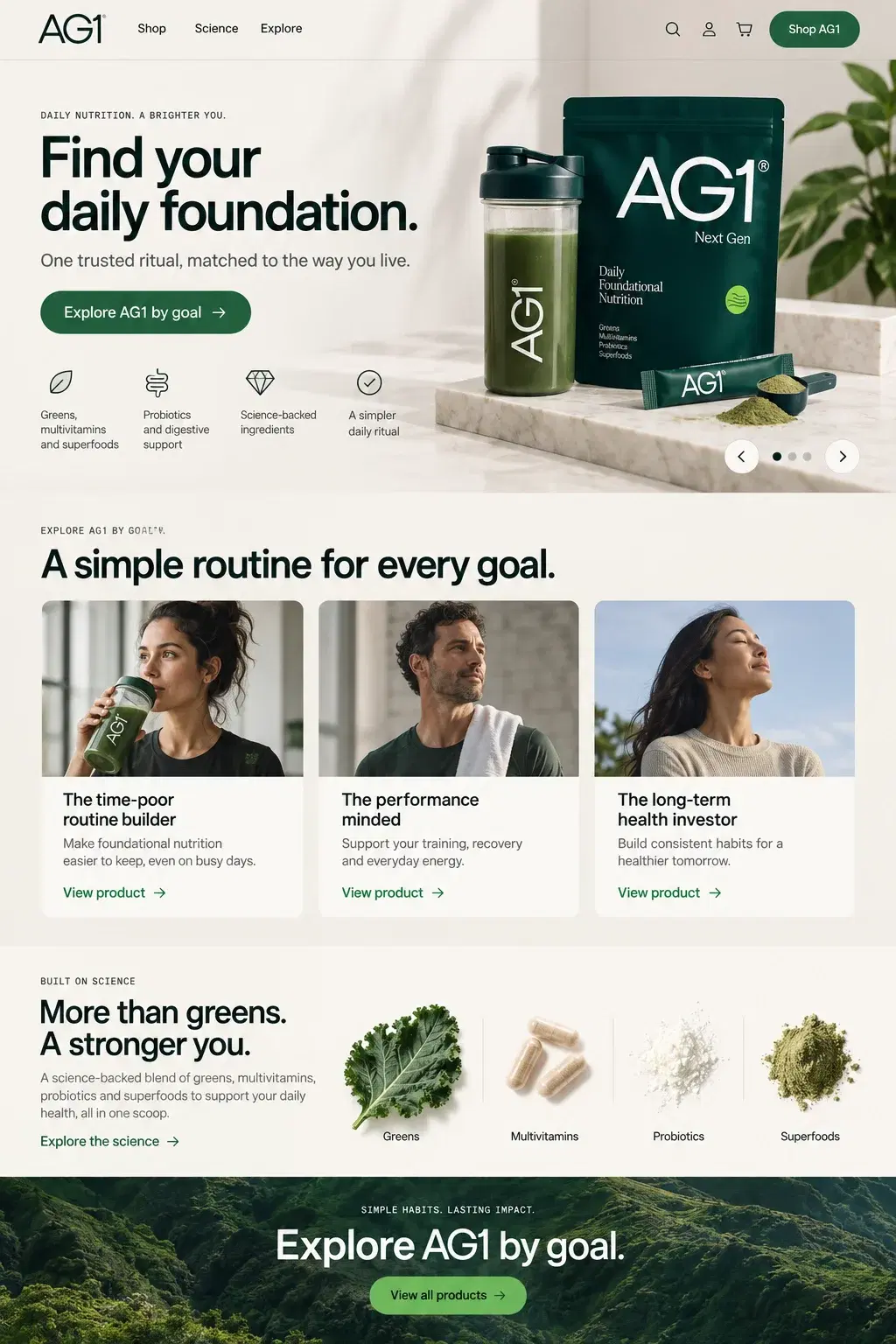
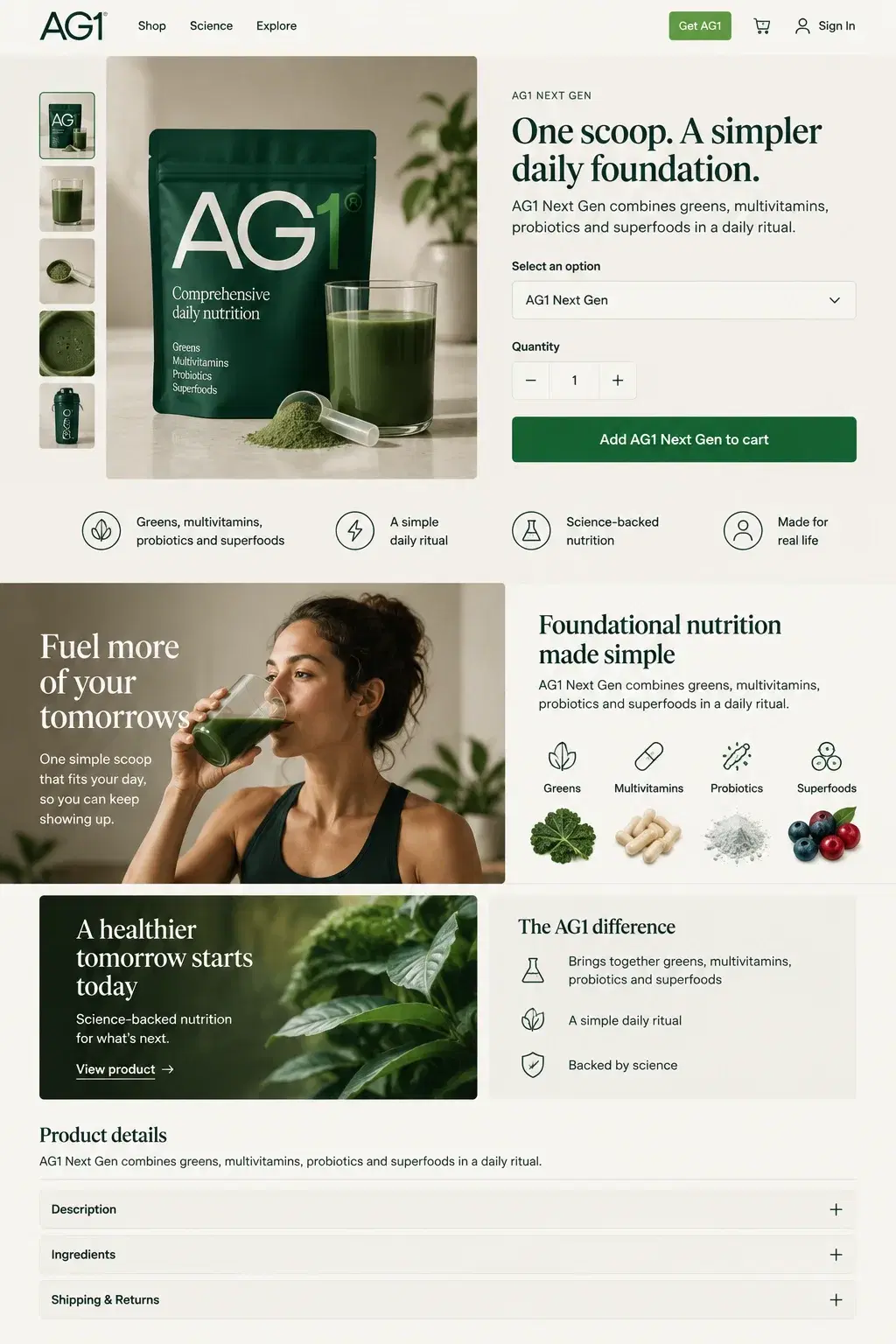
For example, below is what we built from this AG1 analysis using AlphaWeb. In around 20 to 30 minutes, it went from an idea to a complete working store website, with payments, subscriptions, bundles, upsells and downsells wired in, end to end, through Stripe and PayPal.
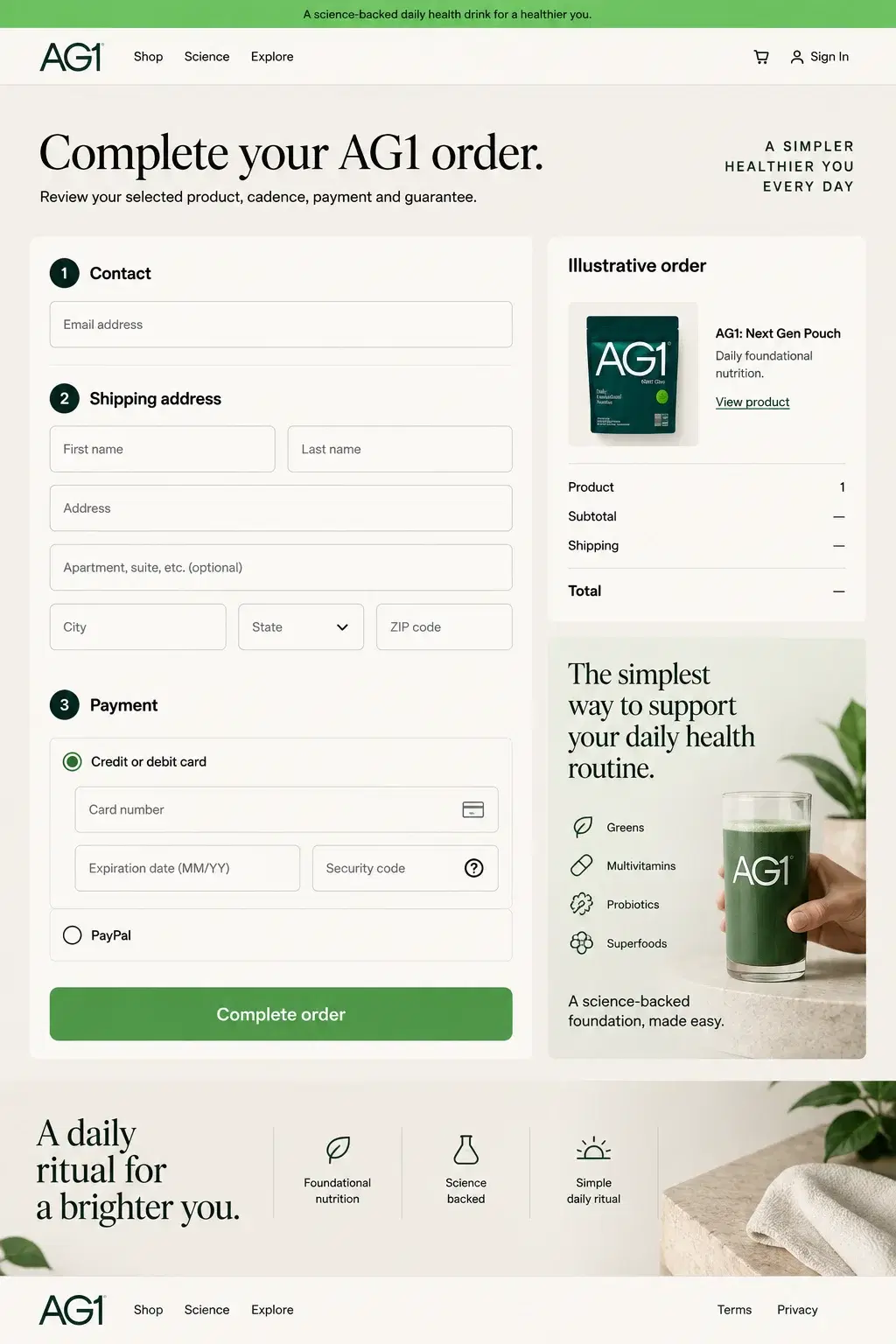
AlphaWeb is fully AI-agnostic. Use GPT-5.6 Luna for fast, cost-effective builds, or step up to Claude Opus or Fable when you want more depth in the strategy, copy, creative direction and execution. We keep adding the best frontier and open-source models, so you can choose what makes sense for the job.
You don’t need a big creative and development project to test an idea anymore. Take an opportunity from the analysis, turn it into a real customer journey, and start driving traffic, in a matter of hours.
You can also steer the transformation towards what your business needs. That might mean stronger direct-response ads and funnels, a premium design direction or full rebrand, or a business plan exploring pricing, bundles and different growth scenarios.
If you like the plan, you can press Go and AlphaWeb can turn it into a working journey for your business. The analysis becomes something your customers can actually experience, and something you can measure.
Run your free Glow Up, see what score your brand gets, and choose the first hyper-specific customer journey you want to build.
Run your free Glow Up
See what score your brand gets and choose the first hyper-specific customer journey you want to build.